

The Gulf Cooperation Council (GCC) has become one of the world’s most important destinations for skilled and experienced workers. Countries such as the United Arab Emirates, Saudi Arabia, Qatar, Kuwait, Oman, and Bahrain continue to invest in construction, infrastructure, healthcare, hospitality, logistics, manufacturing, technology, and other industries. As these sectors expand, employers are increasingly looking for workers who can bring practical skills, flexibility, and professional experience to the workplace.
One growing trend is the demand for multi-skilled Pakistani workers. Pakistani professionals and skilled workers have long contributed to the development of Gulf economies, and their technical abilities, work ethic, adaptability, and experience make them attractive candidates for a wide range of GCC jobs.
But why exactly are GCC employers looking for multi-skilled Pakistani workers? The answer lies in changing workforce requirements, large-scale development projects, the need for operational flexibility, and the valuable combination of technical and practical skills that many Pakistani workers offer.
In this article, we explore the major reasons behind this demand and explain why Pakistani skilled workers for GCC countries can be an excellent workforce solution for employers.
The Growing Demand for Skilled Workers in GCC Countries
GCC countries are experiencing significant economic and industrial development. Although the region has historically relied heavily on oil and gas, many GCC economies are actively diversifying into new industries.
Major investments are being made in:
- Construction and infrastructure
- Real estate and property development
- Logistics and transportation
- Healthcare
- Hospitality and tourism
- Manufacturing
- Renewable energy
- Information technology
- Retail and commercial services
- Engineering and technical industries
These industries require a large workforce with different levels of expertise. Employers are not simply looking for people who can perform one task. Increasingly, they want employees who can handle multiple responsibilities, adapt to different working conditions, and support teams across various operational requirements. This is where multi-skilled Pakistani workers can provide significant value.
What Does ‘Multi-Skilled Worker’ Mean?
A multi-skilled worker is someone who possesses more than one relevant skill or area of expertise. Instead of being limited to a single responsibility, such workers can perform different tasks within their profession or support related functions.
For example, a construction worker may have experience in several areas, such as:
- General construction
- Equipment handling
- Basic maintenance
- Site safety
- Material management
Similarly, a technician may understand electrical systems, mechanical maintenance, troubleshooting, and equipment installation. In healthcare, hospitality, logistics, and other industries, employees with multiple practical abilities can help organizations operate more efficiently.
For GCC employers, hiring workers with broader capabilities can make it easier to manage changing operational requirements.
Why GCC Employers Are Looking for Multi-Skilled Pakistani Workers
1. Pakistan Has a Large Skilled Workforce
Pakistan has a large and diverse labor force that includes professionals, technicians, tradespeople, healthcare workers, engineers, drivers, hospitality staff, construction workers, and other skilled employees.
Many Pakistani workers receive technical or vocational training before entering the workforce. Others develop their expertise through years of practical experience. This creates a broad talent pool for international employers seeking qualified candidates.
Pakistani skilled workers for GCC countries can be found across numerous industries, making Pakistan an important recruitment market for Gulf employers.
2. Strong Technical and Practical Skills
One of the major advantages of Pakistani workers is their combination of theoretical knowledge and practical experience.
Employers in technical industries often require workers who understand not only how equipment or systems work but also how to identify problems and perform practical tasks.
For example, skilled technicians may have experience with:
- Electrical installations
- Mechanical systems
- HVAC equipment
- Industrial machinery
- Plumbing
- Maintenance
- Welding
- Construction equipment
Workers with several related skills can be particularly valuable because they may be able to support different aspects of an operation.
3. Adaptability to Different Work Environments
The GCC workforce is highly international. Employees often work alongside people from different countries, cultures, and professional backgrounds. Adaptability is therefore an important quality.
Many Pakistani workers have experience working in diverse environments and adapting to different workplace expectations. Their ability to adjust to new teams, schedules, responsibilities, and procedures can make the transition into GCC employment easier.
For employers, adaptable workers can be useful when projects change or when employees need to take on additional responsibilities.
4. Experience in Construction and Infrastructure
Construction remains an important employment sector across the GCC. Large residential developments, commercial buildings, transportation infrastructure, industrial facilities, and tourism projects require thousands of skilled workers.
Pakistani workers have extensive experience in construction-related professions, including:
- Civil engineering
- Electrical work
- Plumbing
- Welding
- Masonry
- Carpentry
- Equipment operation
- Site supervision
- Quantity surveying
- Health and safety
A worker with multiple construction-related capabilities can provide additional flexibility to employers managing large projects.
5. Growing GCC Infrastructure Projects
GCC countries continue to develop major infrastructure and economic projects. These projects require employees across multiple levels, from engineers and project managers to technicians and skilled tradespeople.
Employers need workers who can contribute effectively from the beginning of a project and maintain productivity throughout different stages.
This has increased interest in skilled manpower recruitment for GCC countries, particularly for candidates who have proven experience and relevant technical qualifications.
Multi-Skilled Workers Can Improve Workforce Flexibility
Workforce flexibility is becoming increasingly important for international employers. A company may experience periods when certain skills are needed more than others. Employees who possess multiple related skills can potentially support different tasks depending on operational requirements.
For example, a maintenance technician with electrical and mechanical knowledge may be able to assist with several maintenance responsibilities.
Likewise, a hospitality employee with customer service, food preparation, and basic operational skills may be useful in different departments. This flexibility can help employers build teams that are better prepared for changing workloads.
Pakistani Workers and the Importance of Work Ethic
Professional attitude and reliability are important factors when employers recruit internationally. Many Pakistani workers have established careers in demanding industries where punctuality, teamwork, responsibility, and practical problem-solving are essential.
Employers often look for candidates who can:
- Follow workplace procedures
- Work effectively in teams
- Meet deadlines
- Follow safety requirements
- Communicate professionally
- Adapt to changing responsibilities
- Maintain productivity
These qualities, combined with professional skills, can make candidates more attractive to GCC employers.
The Role of Professional Recruitment Agencies
Finding the right international candidate is not simply about locating someone with a particular job title. Employers need to verify qualifications, experience, technical abilities, documentation, and suitability for the position. This is why international recruitment agencies in Pakistan can play an important role.
A professional recruitment agency can help employers with processes such as:
- Understanding workforce requirements
- Identifying suitable candidates
- Screening CVs and applications
- Conducting candidate interviews
- Assessing qualifications and experience
- Shortlisting suitable workers
- Coordinating documentation
- Supporting recruitment and deployment processes
Effective candidate screening can help employers reduce the time spent reviewing unsuitable applications and focus on candidates who better match their requirements.
Candidate Screening Matters for GCC Employers
Hiring internationally involves significant responsibility. Employers need confidence that candidates have the skills and experience stated on their applications.
A structured candidate screening process can help identify suitable workers based on factors such as:
- Educational qualifications
- Professional certifications
- Work experience
- Technical skills
- Industry background
- Communication abilities
- Job-specific requirements
For multi-skilled workers, screening is particularly important because employers need to understand the full range of a candidate’s capabilities. A detailed assessment can reveal whether a candidate genuinely has experience in multiple areas or simply lists additional skills on a CV.
Demand for Skilled Pakistani Workers Across Multiple Industries
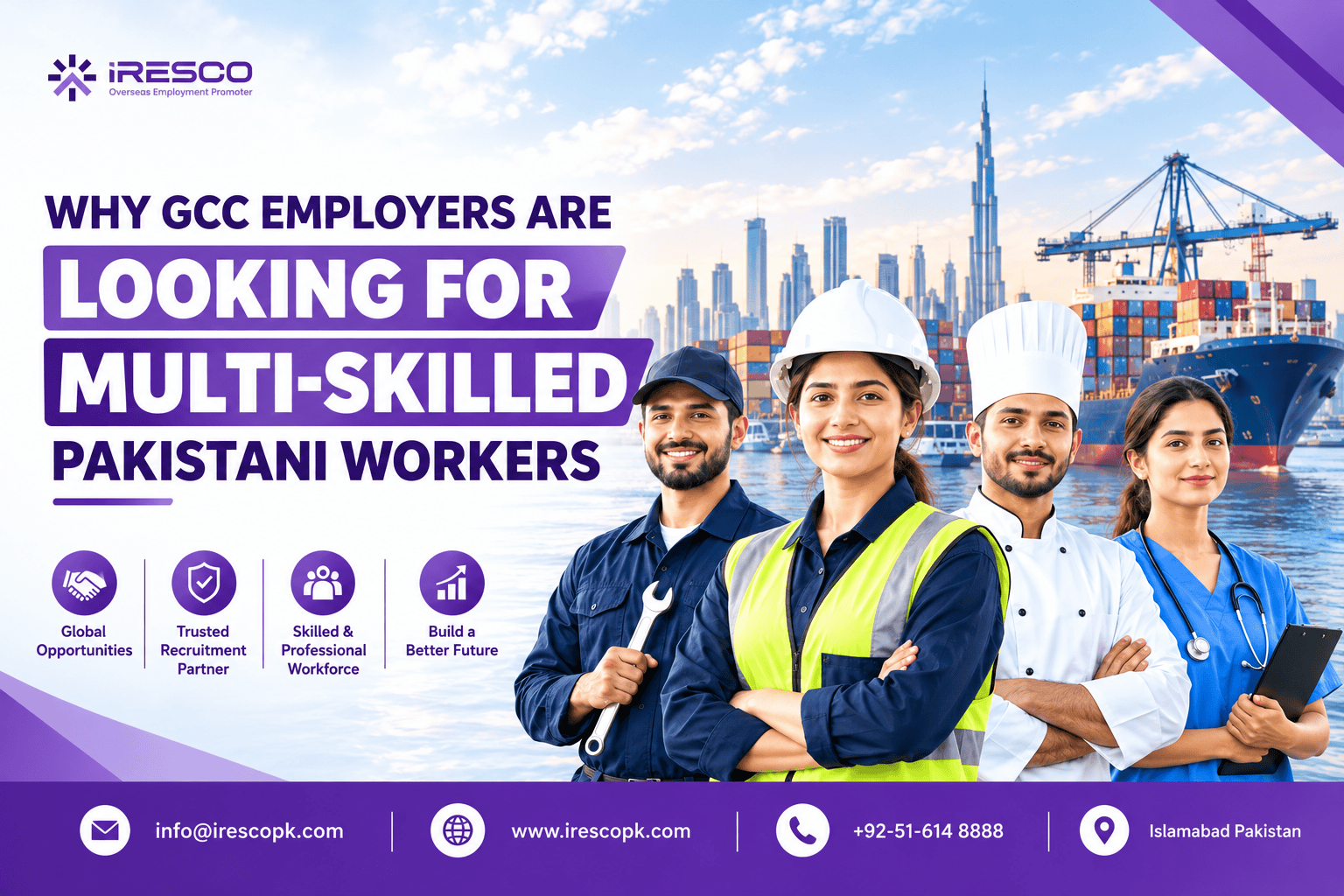
The demand for Pakistani workers is not limited to construction.
Construction and Engineering
Construction companies require engineers, supervisors, electricians, plumbers, welders, carpenters, machine operators, and other skilled professionals.
Healthcare
Hospitals and healthcare organizations may require qualified doctors, nurses, technicians, pharmacists, and support staff, subject to the relevant licensing and regulatory requirements.
Hospitality
Hotels, restaurants, resorts, and tourism businesses require chefs, kitchen staff, housekeeping personnel, supervisors, customer service employees, and other hospitality professionals.
Logistics and Transportation
The expansion of e-commerce and international trade has increased the importance of logistics. Drivers, warehouse workers, logistics coordinators, technicians, and supply-chain professionals can support this sector.
Manufacturing and Industrial Operations
Factories and industrial facilities require machine operators, maintenance technicians, engineers, production workers, and supervisors.
This wide range of industries demonstrates why Pakistan can be an important source of international talent for GCC businesses.
Why Employers Prefer Skills Over Job Titles
Modern employers increasingly focus on what candidates can actually do rather than relying exclusively on job titles. Two workers may have the same job title but completely different skill sets.
For example, a technician with five years of experience in one narrow task may have less flexibility than a technician with three years of experience across several related systems.
This is why multi-skilled Pakistani workers can be valuable to organizations that need employees capable of handling diverse responsibilities.
Skills-based recruitment allows employers to identify candidates based on actual competencies and business requirements.
The Importance of Proper Documentation and Compliance
International recruitment also requires careful attention to documentation and legal requirements.
Depending on the GCC country and profession, candidates may need relevant:
- Educational certificates
- Professional certifications
- Experience letters
- Medical documentation
- Passport and visa documentation
- Licensing or registration
- Other employment-related paperwork
Employers and recruitment partners should follow the applicable laws and regulations of both the recruitment country and destination country. A professional recruitment process should prioritize transparency, proper documentation, ethical recruitment practices, and compliance.
How Pakistani Workers Can Prepare for GCC Employment
Pakistani workers who want to build careers in the GCC can improve their opportunities by developing both technical and professional skills.
Candidates should consider:
Developing Multiple Related Skills
Learning complementary skills can increase professional versatility.
Obtaining Recognized Certifications
Relevant certifications can help demonstrate technical competence.
Improving Communication Skills
Good communication can be important in multicultural GCC workplaces.
Building Relevant Experience
Practical industry experience can strengthen a candidate’s profile.
Maintaining Accurate Documentation
Candidates should keep educational and professional documents organized and up to date.
Understanding Workplace Safety
Safety awareness is particularly important in construction, manufacturing, engineering, and industrial environments.
The Future of Pakistani Recruitment for GCC Employers
As GCC economies continue to diversify, workforce requirements are likely to evolve. Employers may increasingly look for candidates who combine technical expertise with adaptability, communication, teamwork, and problem-solving abilities. This means the future of Pakistan’s GCC recruitment is likely to involve more skills-based and carefully screened hiring.
Rather than simply filling vacancies, employers can benefit from recruitment strategies that identify candidates whose skills align closely with specific business requirements.
For Pakistani professionals and skilled workers, this creates opportunities to build international careers while contributing their expertise to growing GCC industries.
How Employers Can Find the Right Pakistani Workers
For GCC companies, successful international recruitment starts with clearly defining the position.
Employers should identify:
- Required technical skills
- Minimum experience
- Educational qualifications
- Certifications
- Language requirements
- Job responsibilities
- Working conditions
- Salary and benefits
- Country-specific compliance requirements
Once these requirements are clear, recruitment professionals can help identify and screen suitable candidates. A structured approach can improve the quality of recruitment while reducing the risk of hiring candidates who do not match the actual requirements of the position.
Conclusion
The question of why GCC employers are looking for multi-skilled Pakistani workers can be answered through several important factors: Pakistan’s large skilled workforce, practical technical expertise, adaptability, industry experience, and the growing need for flexible employees across GCC economies.
From construction and engineering to healthcare, hospitality, logistics, and manufacturing, Pakistani professionals and skilled workers can contribute to a wide range of industries. For employers, recruiting the right candidates requires more than simply reviewing CVs. Proper screening, qualification verification, skills assessment, documentation, and compliance are essential parts of successful international recruitment.
As GCC countries continue investing in infrastructure, tourism, technology, logistics, and other industries, demand for qualified international talent is expected to remain important. Multi-skilled Pakistani workers can therefore represent a valuable workforce option for GCC employers seeking capable, adaptable, and experienced employees.
Frequently Asked Questions (FAQs)
1. Why are GCC employers interested in Pakistani workers?
GCC employers are interested in Pakistani workers because Pakistan has a large pool of skilled professionals and experienced workers across construction, engineering, healthcare, hospitality, logistics, manufacturing, and other industries.
2. What are multi-skilled Pakistani workers?
Multi-skilled Pakistani workers are professionals or skilled employees who possess several related abilities and can perform different tasks within their field. Their broader skill sets can provide employers with greater workforce flexibility.
3. Which GCC countries hire Pakistani skilled workers?
Pakistani workers are employed across GCC countries, including the United Arab Emirates, Saudi Arabia, Qatar, Kuwait, Oman, and Bahrain, across a wide variety of industries and professions.
4. How can GCC employers recruit skilled workers from Pakistan?
Employers can work with professional international recruitment agencies to define their requirements, source candidates, screen applications, assess qualifications and experience, and coordinate the recruitment process in accordance with applicable regulations.
5. What skills can improve a Pakistani worker’s chances of GCC employment?
Technical expertise, relevant certifications, practical experience, communication, workplace safety knowledge, adaptability, and additional complementary skills can strengthen a candidate’s profile for GCC employment.
