

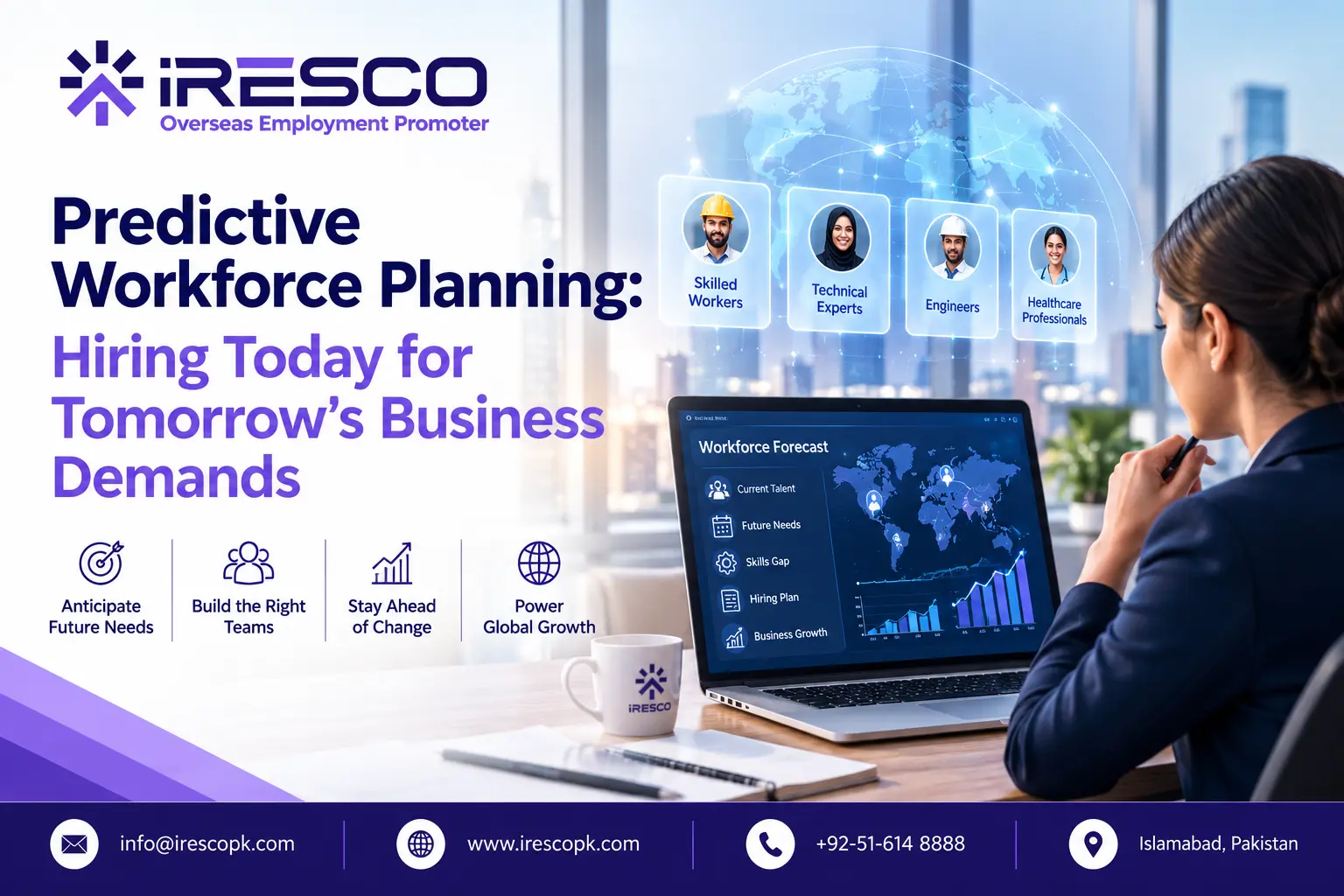
The business world is changing faster than ever, and companies can no longer rely on traditional hiring methods to meet their future workforce needs. Skills shortages, technological advancements, changing customer expectations, and international competition are forcing employers to rethink how they attract, recruit, and retain talent. Predictive workforce planning offers a forward-looking approach that helps organizations anticipate staffing requirements, identify skill gaps, and build capable teams before workforce challenges affect business performance.
For employers operating in Saudi Arabia, the UAE, Kuwait, Qatar, Bahrain, and other international markets, workforce planning has become an essential part of sustainable business growth. Organizations need the right people with the right skills at the right time. By combining workforce data, strategic recruitment, and expert manpower planning, businesses can prepare for future demands rather than simply reacting to immediate vacancies.
IRESCO supports international employers through professional recruitment and overseas employment solutions, connecting businesses with qualified Pakistani professionals, skilled workers, and technical talent for a range of industries. With a strategic approach to international recruitment, employers can strengthen their workforce, improve operational efficiency, and prepare for long-term success.
What Is Predictive Workforce Planning?
Predictive workforce planning is a strategic process that uses workforce data, business forecasts, industry trends, and recruitment insights to estimate an organization’s future staffing needs. It helps employers understand which positions they will need to fill, what skills their workforce must possess, and when additional employees may be required.
Traditional recruitment often begins when an employee resigns, a project starts, or a department experiences a staffing shortage. Predictive workforce planning takes a different approach. It identifies potential workforce gaps early and allows companies to develop a structured hiring strategy before those gaps become operational problems.
For example, a construction company preparing for a major infrastructure project may need hundreds of skilled workers, engineers, equipment operators, and supervisors. Rather than waiting until the project begins, the company can forecast its manpower requirements and coordinate recruitment in advance.
Similarly, a manufacturing business anticipating increased production can identify future requirements for technicians, maintenance specialists, quality controllers, and production managers.
This proactive approach transforms recruitment from an administrative activity into a strategic business function.
Why Predictive Workforce Planning Matters for Modern Businesses
Workforce challenges can affect productivity, profitability, customer satisfaction, and business continuity. When companies fail to anticipate their staffing needs, they may experience recruitment delays, increased overtime costs, missed deadlines, and difficulties maintaining service quality. Predictive workforce planning helps businesses address these challenges through informed decision-making.
1. Anticipating Future Recruitment Needs
Businesses need to understand how expansion plans, new contracts, seasonal demand, and employee turnover may affect staffing requirements. Workforce forecasting helps organizations estimate how many employees they will need and which roles will become critical.
This information allows HR departments to prepare recruitment schedules, allocate hiring budgets, and build candidate pipelines ahead of demand.
2. Reducing Recruitment Delays
Some positions require specialized qualifications, technical experience, certifications, or international recruitment arrangements. Finding suitable candidates at short notice can be difficult, especially when several employers compete for the same skills.
By identifying future vacancies early, companies can begin candidate sourcing, screening, and skills assessment before urgent hiring becomes necessary.
3. Controlling Hiring Costs
Unplanned recruitment can increase advertising expenses, agency costs, overtime payments, and the financial impact of vacant positions. Emergency hiring may also pressure employers into making decisions without sufficient candidate evaluation.
A structured workforce planning strategy helps businesses organize recruitment activities, prioritize essential positions, and make better use of available budgets.
4. Improving Workforce Productivity
Having the right number of employees is only one part of effective workforce management. Businesses also need workers whose skills match their operational requirements.
Predictive workforce planning identifies competency gaps and helps employers decide whether to recruit new talent, train existing employees, or reorganize responsibilities.
5. Supporting Long-Term Business Growth
Expansion into new markets, the introduction of new technology, and the launch of major projects all create new workforce requirements.
Companies that align hiring decisions with their business objectives are better positioned to manage growth without compromising operational performance.
How Predictive Workforce Planning Works
Effective workforce forecasting requires more than estimating how many employees a business may need. It involves understanding current workforce capabilities, evaluating future business objectives, and translating those findings into a practical recruitment strategy.
Step 1: Analyze the Existing Workforce
The first step is to evaluate the organization’s current workforce. Employers should review employee numbers, job roles, qualifications, experience, performance, turnover rates, and retirement expectations where relevant.
This assessment establishes a baseline for future planning.
For example, an industrial company may discover that it has enough general laborers but lacks experienced electrical technicians and maintenance engineers. Understanding this difference helps the organization focus its recruitment efforts on the most important skill gaps.
Step 2: Forecast Future Business Requirements
Workforce requirements should reflect the company’s business plans. HR teams should work with department managers, operations teams, finance professionals, and project leaders to identify expected changes.
Important forecasting factors include:
- Planned business expansion and new contracts.
- Expected production or service demand.
- New technology and changing job responsibilities.
- Employee turnover and workforce availability.
- Project deadlines and seasonal staffing requirements.
- Regulatory, certification, and occupational requirements.
By connecting these factors with workforce data, organizations can estimate future hiring needs more accurately.
Step 3: Identify Skills Gaps
A skills gap exists when the capabilities available within an organization do not fully meet its current or anticipated requirements.
Businesses should compare existing employee skills with the competencies required for future operations. This comparison helps determine whether recruitment, training, internal promotion, or workforce restructuring is the most appropriate solution.
For international employers, common requirements may include technical expertise, engineering qualifications, industrial safety knowledge, healthcare credentials, equipment operation, and supervisory experience.
Step 4: Develop a Predictive Recruitment Strategy
Once future staffing requirements are identified, employers can create a recruitment roadmap that specifies which positions must be filled, when recruitment should begin, and which sourcing channels are most suitable.
A predictive recruitment strategy may include local hiring, international recruitment, internal talent development, and partnerships with professional recruitment agencies.
For employers seeking skilled workers from Pakistan, working with an experienced overseas recruitment agency can help organize candidate sourcing, preliminary screening, interview coordination, and relevant employment documentation.
Step 5: Monitor Results and Update Forecasts
Workforce planning should be reviewed regularly because business conditions can change. Unexpected contracts, employee departures, budget adjustments, and changes in project schedules may affect staffing requirements.
Employers should compare workforce forecasts with actual hiring results and update their plans accordingly. This continuous process helps organizations improve forecasting accuracy and respond to changing business demands.
The Role of AI and Data Analytics in Workforce Forecasting
Artificial intelligence and workforce analytics are changing how businesses evaluate talent requirements and plan recruitment activities. These technologies can help HR professionals identify patterns that may be difficult to recognize through manual analysis alone.
For example, workforce analytics tools can evaluate historical turnover, hiring timelines, retirement trends, employee availability, and projected business growth. When reliable data is available, predictive models can estimate potential staffing shortages and highlight roles that may require early recruitment.
Predictive Analytics for Smarter Hiring Decisions
Predictive analytics uses historical and current data to estimate possible future outcomes. In recruitment, it can help employers forecast hiring volumes, identify hard-to-fill positions, and understand which skills may become more important.
These insights can support decisions about recruitment budgets, candidate sourcing, and hiring timelines.
However, forecasts are not guarantees. Their reliability depends on data quality, appropriate assumptions, and regular review.
AI-Powered Recruitment and Candidate Screening
AI-powered recruitment tools can assist with organizing applications, matching relevant qualifications to job requirements, and managing large candidate databases. For bulk recruitment campaigns, these capabilities may help recruiters process applications more efficiently.
Human judgment remains essential. Employers and recruiters must verify qualifications, evaluate practical skills, consider candidate suitability, and ensure fair hiring practices.
AI should support informed recruitment decisions rather than replace professional assessment.
Skills-Based Workforce Planning
Job titles alone do not always reveal whether a candidate possesses the capabilities required for a role. Skills-based workforce planning focuses on demonstrable competencies, relevant experience, and job-specific requirements. This approach can help employers identify suitable candidates from a broader talent pool and understand where additional training may be needed.
For companies recruiting internationally, combining skills assessments with structured interviews and qualification verification can support better hiring decisions.
Predictive Workforce Planning and International Recruitment
International recruitment is an important option for businesses facing shortages of specialized or skilled talent. However, overseas hiring involves multiple stages, including candidate sourcing, qualification checks, interviews, employment documentation, and applicable immigration procedures. Predictive workforce planning gives employers more time to coordinate these activities.
Preparing for International Talent Requirements
Employers should identify international recruitment needs as early as possible. This includes determining the number of workers required, defining essential qualifications, setting realistic recruitment timelines, and establishing employment terms.
Early planning is particularly important when recruitment involves technical specialists, large project teams, or multiple job categories. A clear workforce forecast also helps recruitment partners develop targeted sourcing strategies rather than relying on general candidate searches.
Recruiting Skilled Workers from Pakistan
Pakistan offers a diverse pool of professionals and skilled and semi-skilled workers across several industries. Depending on the role and individual qualifications, employers may recruit engineers, healthcare professionals, construction workers, electricians, welders, technicians, equipment operators, and hospitality personnel.
An international recruitment agency in Pakistan can help employers coordinate the recruitment process by identifying potential candidates, conducting preliminary screening, arranging interviews, and supporting relevant documentation.
IRESCO provides overseas recruitment and manpower recruitment services for international employers seeking qualified Pakistani talent. The objective is to align candidate capabilities with employer requirements while supporting a structured and transparent hiring process.
Building a Reliable Candidate Pipeline
A candidate pipeline is a pool of potential applicants who may be suitable for current or future vacancies. Instead of beginning the search from scratch every time a new project is announced, employers and recruitment partners can maintain organized talent pools for recurring roles.
For example, a company regularly recruiting industrial technicians may benefit from a pipeline of screened candidates whose qualifications and experience can be reviewed when new requirements arise.
Candidate information must be handled appropriately, with attention to privacy, consent, data accuracy, and applicable employment regulations.
Predictive Workforce Planning in Saudi Arabia and the GCC
Employers across the Gulf Cooperation Council (GCC) operate in diverse industries with changing staffing requirements. Construction, manufacturing, healthcare, hospitality, oil and gas, facilities management, and industrial services may all require careful workforce forecasting.
The appropriate recruitment strategy depends on each employer’s projects, location, skill requirements, and applicable regulations.
Saudi Arabia: Aligning Recruitment With Project Requirements
Saudi Arabia’s ongoing economic diversification and infrastructure development create workforce planning considerations for employers across multiple sectors. Businesses involved in construction, engineering, industrial operations, healthcare, hospitality, and facilities management need to assess their future staffing requirements carefully.
Predictive workforce planning can help employers identify critical vacancies, estimate recruitment lead times, and organize sourcing for specialized positions.
Companies seeking a recruitment agency in Saudi Arabia or an overseas recruitment partner should define their manpower requirements clearly, including job descriptions, experience, qualifications, compensation, and expected joining dates.
IRESCO supports international employers seeking Pakistani talent for overseas employment opportunities, helping connect workforce requirements with relevant recruitment activities.
UAE: Planning for Changing Business Needs
In the United Arab Emirates, businesses across construction, logistics, hospitality, healthcare, and professional services may experience changing talent requirements as operations expand or market conditions evolve.
Workforce forecasting helps employers determine when additional employees are needed and which competencies will support future operations.
A proactive recruitment strategy can also help businesses coordinate hiring across multiple departments while maintaining consistent candidate evaluation standards.
Kuwait, Qatar, and Bahrain: Strategic Manpower Planning
Employers in Kuwait, Qatar, and Bahrain may need skilled and semi-skilled workers for industrial operations, construction, maintenance, hospitality, healthcare, and other business activities.
Predictive workforce planning helps companies align recruitment timelines with project schedules and operational priorities.
International recruitment should always account for the relevant country’s employment laws, work authorization requirements, professional licensing rules, and applicable recruitment procedures.
Industries That Benefit From Predictive Workforce Planning
Although workforce forecasting is valuable for almost every organization, it is especially useful in industries where staffing shortages can directly affect project delivery, safety, or service quality.
Construction and Infrastructure
Construction projects depend on coordinated teams of engineers, supervisors, electricians, welders, equipment operators, and other skilled workers. Predictive manpower planning helps contractors estimate labor requirements across different project phases and arrange recruitment before critical deadlines.
Oil and Gas
Oil and gas operations may require specialized engineers, mechanical technicians, instrumentation specialists, safety professionals, and experienced industrial workers.
Forecasting allows employers to prepare for maintenance schedules, project mobilization, and technical staffing requirements.
Manufacturing and Industrial Operations
Manufacturing companies must balance production targets with employee availability, technical expertise, and equipment maintenance requirements.
Workforce forecasting can help identify future requirements for machine operators, quality control personnel, production supervisors, and maintenance technicians.
Healthcare
Hospitals and healthcare facilities need appropriately qualified professionals to maintain service quality and meet patient demand.
Workforce planning can help identify anticipated staffing gaps, specialized skill requirements, and recruitment needs while accounting for applicable licensing and credential verification.
Hospitality and Facilities Management
Hotels, catering businesses, property operators, and facilities management companies may experience fluctuating staffing requirements depending on occupancy, contracts, service demand, and seasonal activity.
Predictive planning can help employers prepare for these changes without relying exclusively on last-minute recruitment.
Key Benefits of Predictive Workforce Planning for Employers
A structured workforce planning approach can deliver several operational and strategic advantages.
Better hiring timelines: Employers can begin recruitment earlier for positions that are difficult to fill.
More effective budget management: Forecasting helps organizations allocate resources according to anticipated hiring needs.
Improved talent availability: Maintaining suitable candidate pipelines can reduce dependence on emergency recruitment.
Stronger skills alignment: Employers can focus on the qualifications and competencies required for future business objectives.
Greater operational continuity: Planned recruitment can reduce the risk of staffing gaps disrupting important activities.
More informed decision-making: Workforce data gives HR leaders and business managers a clearer basis for evaluating staffing priorities.
The actual benefits will depend on the quality of workforce data, the effectiveness of recruitment processes, and how consistently forecasts are reviewed.
Common Workforce Planning Mistakes Businesses Should Avoid
Even well-intentioned workforce strategies can fail when employers rely on incomplete information or treat planning as a one-time exercise.
Relying Only on Historical Data
Past hiring patterns are useful, but they may not reflect future business conditions. New contracts, technological changes, and unexpected market developments can create requirements that historical data cannot fully predict.
Employers should combine historical information with current business plans and realistic future scenarios.
Ignoring Employee Turnover
A workforce forecast that accounts for business expansion but ignores employee departures may underestimate recruitment needs.
Organizations should review turnover trends, retention challenges, and the availability of employees for critical positions.
Starting International Recruitment Too Late
Overseas hiring can involve candidate sourcing, interviews, qualification verification, documentation, and work authorization procedures. Delays at any stage can affect project schedules.
Employers should establish realistic lead times and coordinate with their recruitment partners before vacancies become urgent.
Focusing on Headcount Instead of Skills
Hiring more people does not necessarily solve a workforce problem if the new employees lack the required skills.
Workforce planning should consider the type, level, and availability of expertise needed to achieve operational objectives.
Failing to Review Forecasts
Business conditions change, and workforce plans must change with them. Employers should review forecasts periodically and adjust recruitment priorities when assumptions no longer reflect actual requirements.
How to Build a Future-Ready Workforce Planning Strategy
Businesses do not need to begin with complicated predictive software. A practical workforce planning strategy can start with a few consistent steps.
- Define business objectives. Identify expansion plans, major contracts, production targets, and operational priorities.
- Assess current capabilities. Review workforce numbers, skills, qualifications, turnover, and critical roles.
- Forecast future requirements. Estimate staffing needs across departments, projects, and time periods.
- Prioritize skill shortages. Identify the positions that may take the longest to fill or have the greatest operational impact.
- Choose suitable recruitment channels. Combine internal development, local recruitment, and international talent sourcing where appropriate.
- Coordinate with recruitment partners. Share clear job descriptions, candidate criteria, hiring volumes, and realistic timelines.
- Measure performance. Track time to hire, cost per hire, vacancy duration, retention, and workforce forecast accuracy.
- Update the plan regularly. Reassess assumptions as business needs, labor availability, and project schedules change.
This framework helps employers connect recruitment activities with broader workforce and business strategies.
How IRESCO Supports Predictive Workforce Planning Through International Recruitment
Successful workforce planning depends on having a realistic understanding of future staffing needs and access to suitable recruitment channels. For organizations that need overseas talent, an experienced recruitment partner can help coordinate important stages of the hiring process.
IRESCO, an overseas recruitment and employment services company in Pakistan, supports employers seeking Pakistani professionals and skilled and semi-skilled workers for international employment opportunities.
Its recruitment-related support can include:
- Candidate sourcing based on employer requirements.
- Preliminary screening and interview coordination.
- Recruitment planning for multiple positions and bulk hiring needs.
- Coordination of relevant employment documentation.
- Support for recruitment activities aligned with applicable overseas employment procedures.
- Recruitment support across sectors such as construction, healthcare, manufacturing, oil and gas, and other industrial operations.
The specific services required depend on the employer’s needs, the roles involved, and the applicable legal and regulatory framework.
By communicating staffing requirements early, employers can give their recruitment partner a clearer opportunity to source suitable candidates and organize hiring activities around expected business demand.
For businesses preparing for future projects or expansion, predictive workforce planning can be an important starting point for building a reliable international recruitment strategy.
Conclusion: Hire Today to Prepare for Tomorrow
Predictive workforce planning is becoming an essential part of modern business strategy. Instead of waiting for vacancies and skills shortages to disrupt operations, employers can use workforce data, business forecasts, and strategic recruitment to prepare for future talent requirements.
From identifying critical skills gaps to organizing bulk recruitment and international hiring, a forward-looking approach helps businesses make more informed workforce decisions. It also allows HR teams to connect recruitment priorities with productivity, operational continuity, and long-term growth.
For employers in Saudi Arabia, the UAE, Kuwait, Qatar, Bahrain, and other international markets, access to qualified talent can play an important role in meeting future business demands. Partnering with an experienced overseas recruitment agency can help organizations coordinate their hiring activities and connect with suitable professionals and skilled workers from Pakistan.
IRESCO helps international employers connect with Pakistani talent through professional overseas recruitment and manpower solutions. By planning ahead, defining workforce needs clearly, and building a reliable recruitment pipeline, businesses can move beyond reactive hiring and create a workforce prepared for tomorrow’s opportunities.
Frequently Asked Questions (FAQs)
1. What is predictive workforce planning?
Predictive workforce planning is the process of using workforce data, business forecasts, and skills analysis to estimate future staffing requirements. It helps organizations anticipate vacancies, identify skills gaps, and prepare recruitment strategies before shortages affect operations.
2. How does predictive workforce planning improve recruitment?
It helps employers identify upcoming vacancies earlier, prioritize critical roles, establish candidate pipelines, and coordinate recruitment timelines. This can reduce last-minute hiring pressure and support better workforce decisions.
3. How can AI support predictive workforce planning?
AI and predictive analytics can analyze historical hiring patterns, employee turnover, workforce availability, and projected staffing needs. These tools can support forecasting and recruitment planning, but their results depend on reliable data and appropriate human oversight.
4. Why is predictive workforce planning important for international recruitment?
International recruitment may involve candidate sourcing, interviews, qualification verification, documentation, and work authorization procedures. Early planning gives employers and recruitment partners more time to coordinate these activities and prepare for future staffing needs.
5. How can IRESCO help employers recruit skilled workers from Pakistan?
IRESCO supports international employers with overseas recruitment and manpower sourcing for suitable Pakistani professionals and skilled and semi-skilled workers. Recruitment activities can include candidate sourcing, preliminary screening, interview coordination, and relevant documentation support, depending on the employer’s requirements and applicable regulations.
