

The world of recruitment is changing rapidly, and technology and artificial intelligence (AI) are playing an increasingly important role in how companies find, evaluate, and hire talent. In Oman, this transformation is creating new opportunities for employers, recruitment agencies, and skilled professionals looking for career opportunities.
Traditional recruitment often involves manually reviewing CVs, communicating with candidates, scheduling interviews, and comparing qualifications. While these activities remain important, modern recruitment technology in Oman can make many parts of the process faster, more organized, and more data-driven.
As businesses look for skilled professionals who can contribute to a changing economy, AI-powered recruitment, digital hiring platforms, automated candidate screening, and skills-based talent acquisition are becoming increasingly relevant.
For employers in Oman, the objective is not simply to automate recruitment. The real opportunity is to combine advanced technology with professional human judgment to create a more efficient and effective hiring process.
The Growing Importance of Recruitment Technology in Oman
Recruitment is no longer limited to newspaper advertisements, physical applications, or manually maintained candidate records. Today, employers can use digital platforms to advertise vacancies, receive applications, organize candidate profiles, conduct interviews, and communicate with applicants. Recruitment technology in Oman allows organizations to manage these activities through connected digital systems.
For companies hiring large numbers of employees, technology can significantly simplify administrative processes. Instead of manually sorting hundreds of applications, recruiters can use digital tools to organize candidates according to qualifications, experience, skills, and other job requirements. This is particularly useful for organizations that need to recruit for multiple positions at the same time.
Modern recruitment technology can also support talent acquisition in Oman by helping businesses identify candidates based on their actual skills rather than relying only on previous job titles.
How AI Is Transforming Recruitment in Oman
Artificial intelligence is one of the most important developments in modern recruitment. AI in recruitment can analyze large amounts of information and help recruitment teams identify candidates who meet specific requirements.
For example, an AI-powered recruitment system may analyze CVs and candidate profiles to identify:
- Relevant work experience
- Educational qualifications
- Technical skills
- Professional certifications
- Language abilities
- Industry experience
- Specific job-related keywords
- Transferable skills
This allows recruiters to spend less time performing repetitive screening tasks and more time communicating with qualified candidates.
However, AI should support recruitment professionals rather than completely replace them. Human judgment remains essential when evaluating communication, personality, cultural fit, motivation, leadership ability, and other factors that may not be fully visible in a CV.
AI-Powered Candidate Screening
One of the most common applications of AI-powered recruitment is automated candidate screening. A company advertising a position may receive hundreds of applications. Manually reviewing every CV can take considerable time, especially when recruiters are handling several vacancies simultaneously. AI-powered screening tools can help organize applications according to predefined requirements.
For example, if an employer is searching for an electrical engineer, the recruitment system could identify candidates with relevant engineering qualifications, industry experience, technical certifications, and required skills.
This does not necessarily mean that AI makes the final hiring decision. Instead, it can help recruitment professionals create an organized pool of potentially relevant candidates.
For recruitment in Oman, this approach can help organizations manage larger candidate databases while maintaining a structured recruitment workflow.
Faster Hiring Through Recruitment Automation
Another major advantage of technology is the ability to automate repetitive recruitment activities. Recruiters can spend significant amounts of time sending emails, arranging interviews, updating candidate information, and communicating recruitment-stage updates. Automation can streamline many of these processes.
For example, a digital recruitment platform can help with:
- Application confirmations
- Interview scheduling
- Candidate notifications
- CV organization
- Recruitment-stage tracking
- Candidate database management
- Communication workflows
This can contribute to a faster hiring process in Oman without necessarily reducing the quality of recruitment. The goal of automation should be to remove unnecessary administrative delays while giving recruiters more time to focus on candidates.
Skills-Based Recruitment in Oman
The modern workforce is increasingly focused on skills.
A candidate’s job title does not always provide a complete picture of what that person can do. Someone working under one job title may possess technical, managerial, communication, or digital skills that are relevant to another position.
This is why skills-based recruitment in Oman is becoming increasingly valuable.
Instead of asking only, “What was this person’s previous job?”, recruiters can also ask:
- What skills does the candidate have?
- What technologies can they use?
- What industries have they worked in?
- What certifications have they earned?
- What projects have they completed?
- Which skills can transfer to the new role?
AI and recruitment technology can help organize this information and make it easier to compare candidate capabilities with job requirements. This can support more comprehensive talent matching and help employers discover candidates who may otherwise be overlooked.
Improving Talent Acquisition in Oman With AI
Talent acquisition in Oman is becoming more strategic as employers compete for professionals with specialized skills. Recruitment technology can support this process by helping organizations develop candidate databases, identify skills gaps, analyze recruitment trends, and communicate with potential candidates.
AI can also help recruiters identify patterns in candidate information.
For example, a recruitment organization may identify that employers in a particular sector frequently require professionals with specific technical certifications. This information can then inform future recruitment campaigns and candidate sourcing strategies. Technology therefore becomes more than a hiring tool. It can become part of a broader workforce planning strategy.
Global Talent and International Recruitment in Oman
Digital technology has also changed how companies access international talent.
In the past, international recruitment could require significant communication and administrative coordination. Today, recruiters can connect with candidates through online platforms, digital databases, video interviews, email, and other communication technologies.
This creates opportunities for international recruitment in Oman. Recruitment agencies and employers can use digital systems to identify candidates from different countries, review professional profiles, conduct initial interviews, and organize documentation.
However, international recruitment requires more than technology. Candidate qualifications, experience, documentation, employment requirements, and other relevant factors still need professional review. Technology can make the process more organized, but experienced recruitment professionals remain essential.
How Digital Recruitment Improves the Candidate Experience
Recruitment technology can also benefit job seekers. Candidates increasingly expect recruitment processes to be convenient, accessible, and transparent. A complicated application process can discourage qualified candidates from completing an application.
Digital recruitment in Oman can improve the candidate experience by allowing applicants to:
- Submit applications online
- Upload CVs digitally
- Receive application updates
- Schedule interviews
- Communicate with recruiters
- Access job information
- Complete recruitment documentation electronically
A smoother candidate experience can also contribute to a stronger employer brand.
When companies provide professional communication and organized recruitment processes, candidates can have a clearer understanding of what to expect.
Data-Driven Recruitment Decisions
Recruitment technology also creates access to valuable recruitment data.
Organizations can monitor information such as:
- Number of applications
- Candidate sources
- Screening results
- Interview completion rates
- Time-to-hire
- Recruitment-stage performance
- Skills availability
- Candidate engagement
This information can help employers understand their recruitment processes and identify areas for improvement.
For Oman recruitment agencies, data can also provide insights into changing labor-market requirements.
For example, if employers repeatedly request candidates with specific technical skills, recruitment organizations can focus candidate sourcing and training partnerships around those requirements.
The Role of AI in Candidate Matching
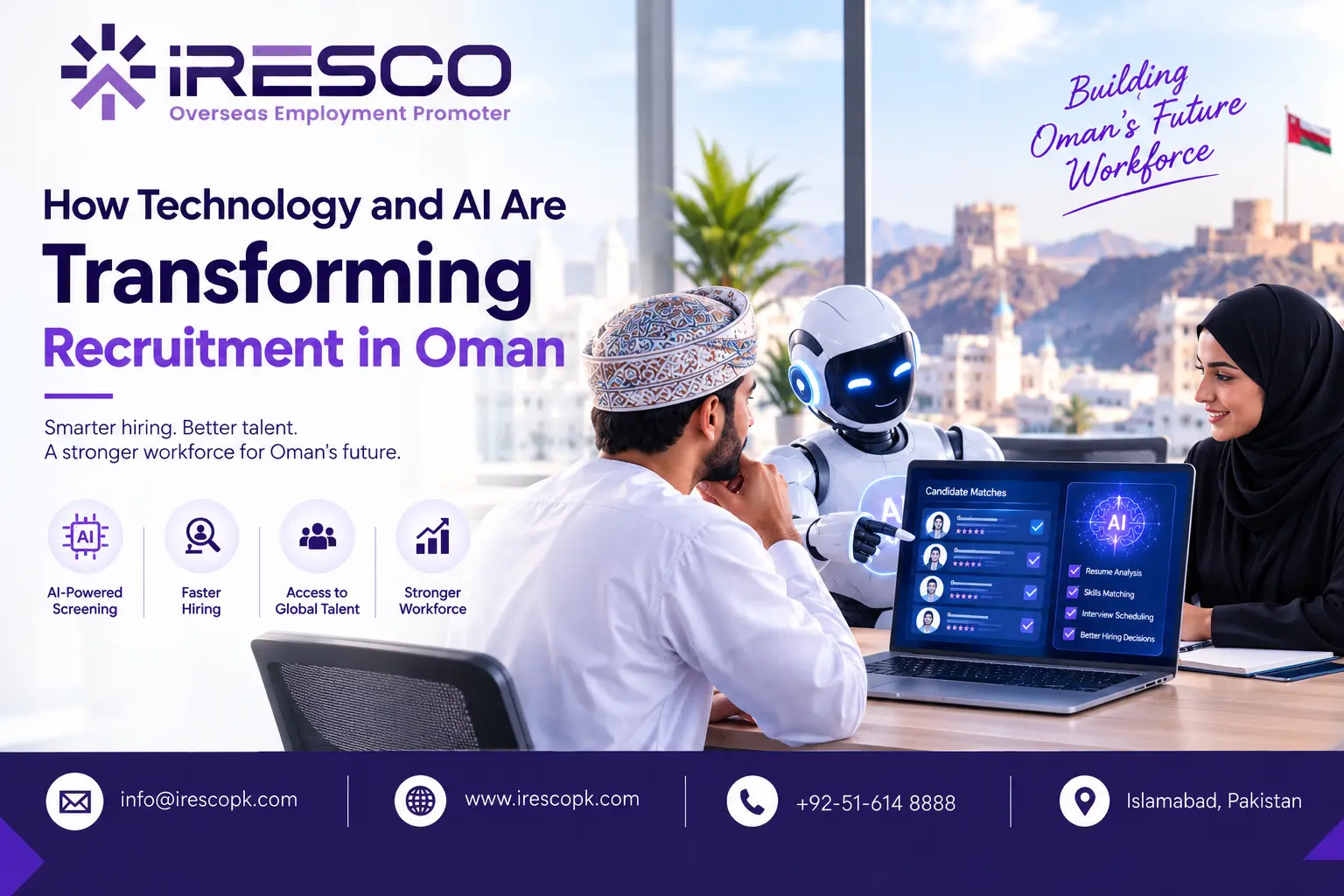
One of the most promising applications of artificial intelligence is AI candidate matching. Traditional recruitment may depend heavily on keywords and job titles. AI-supported systems can potentially analyze broader information from candidate profiles and compare multiple characteristics against a vacancy. A candidate might not have the exact job title listed in an employer’s vacancy but could still possess many of the required skills.
For example, a company searching for a digital marketing specialist might consider candidates with experience in:
- SEO
- Social media marketing
- Content strategy
- Paid advertising
- Analytics
- Market research
- Digital campaigns
AI can help recruiters organize these different skills and identify potential matches. The final assessment should still involve qualified recruitment professionals who can verify the candidate’s actual experience and suitability.
Technology and Oman Vision 2040
The transformation of recruitment technology is also connected to Oman’s broader economic and workforce development goals.
Oman Vision 2040 places importance on developing a skilled and productive workforce, strengthening the labor market, attracting talent, and adapting to economic and technological changes.
As the country’s economy continues to evolve, employers need access to professionals with relevant technical, professional, and digital capabilities.
This makes modern workforce development in Oman increasingly important. Recruitment technology can support this process by helping organizations understand their talent requirements and connect those requirements with available candidates.
The future of recruitment is therefore connected not only to hiring people for today’s vacancies but also to identifying the skills organizations will need in the future.
The Importance of Human Expertise in AI Recruitment
Despite the rapid development of artificial intelligence, recruitment remains a human-centered process.
Technology can process information quickly, but it cannot necessarily understand every aspect of a candidate’s professional potential. Interviews can reveal communication skills, motivation, problem-solving approaches, leadership qualities, and professional expectations.
Human recruiters also play an important role in understanding an employer’s organizational culture and long-term workforce requirements. Therefore, the strongest recruitment model may involve a combination of AI and human recruitment expertise.
AI can assist with repetitive and data-heavy activities, while recruitment professionals can focus on communication, evaluation, relationship management, and final decisions.
Challenges of AI-Powered Recruitment
Although AI provides many opportunities, organizations should also understand its limitations.
Data Quality
AI systems depend on the quality of the information they process. Inaccurate or incomplete candidate information can reduce the usefulness of automated recommendations.
Human Oversight
Recruiters should review AI-generated recommendations rather than automatically accepting them.
Privacy and Data Protection
Recruitment involves sensitive professional and personal information. Organizations should establish appropriate procedures for handling candidate data.
Bias and Fairness
Automated systems should be monitored to ensure that recruitment criteria do not unintentionally create unfair outcomes.
Recruiter Training
Recruitment professionals need to understand how digital tools work and how to interpret their results effectively. These considerations are important when implementing AI recruitment in Oman or any other modern recruitment environment.
The Future of Recruitment in Oman
The future of recruitment in Oman is likely to involve greater integration between artificial intelligence, automation, digital platforms, workforce analytics, and human recruitment expertise.
Recruiters may increasingly use AI to:
- Screen candidate profiles
- Identify skills
- Match candidates to vacancies
- Organize recruitment databases
- Automate communications
- Schedule interviews
- Analyze recruitment data
- Support workforce planning
At the same time, human recruiters will remain important for interviews, candidate relationships, verification, and final hiring decisions. This combination can create a recruitment environment where technology handles repetitive processes while professionals focus on the human elements of hiring.
Preparing Employers for the Future of Hiring
Organizations looking to adopt recruitment technology in Oman should begin by identifying their most time-consuming recruitment activities.
The first step can be determining which tasks are repetitive and suitable for automation. The second step is establishing clear job requirements. AI systems are more useful when employers understand the skills and qualifications required for each position.
The third step is maintaining accurate candidate data.
Finally, recruitment teams should continuously review technology-generated recommendations and monitor recruitment outcomes. Technology should not be adopted simply because it is new. It should solve genuine recruitment challenges and help organizations connect with qualified talent more efficiently.
Building a Stronger Workforce Through Technology
Technology can play an important role in building a future-ready Oman workforce.
Employers need professionals who can adapt to changing technologies, while candidates need opportunities to develop skills that remain relevant in a changing economy.
Recruitment technology can help connect these two requirements. By identifying skills more effectively, improving candidate matching, simplifying recruitment processes, and supporting data-driven workforce planning, AI can contribute to a more connected employment ecosystem.
For recruitment companies, this means moving beyond simply filling vacancies. Modern talent acquisition in Oman can involve understanding employer requirements, identifying candidate capabilities, and creating longer-term connections between skills and workforce demand.
Conclusion
Technology and AI are transforming recruitment in Oman by changing how employers search for candidates, evaluate skills, manage applications, and build their future workforce.
From AI-powered candidate screening and automated hiring processes to skills-based recruitment, digital talent acquisition, and international candidate sourcing, technology offers recruitment organizations new ways to improve efficiency and organization.
However, technology works best when combined with human expertise. AI can process information and support recruiters, but professional judgment remains essential for interviews, candidate evaluation, communication, and final hiring decisions.
As Oman continues developing its economy and workforce under the broader direction of Oman Vision 2040, recruitment technology can support employers in identifying the skills they need while helping qualified professionals connect with new opportunities.
The future of AI recruitment in Oman is therefore not simply about replacing traditional recruitment. It is about creating smarter, more organized, skills-focused, and technology-enabled recruitment processes that support both employers and candidates.
Frequently Asked Questions (FAQs)
1. How is AI transforming recruitment in Oman?
AI is transforming recruitment by helping organizations screen CVs, identify relevant skills, match candidates with vacancies, organize recruitment data, and automate repetitive administrative tasks. Human recruiters can then focus on interviews, communication, verification, and final hiring decisions.
2. What are the benefits of AI-powered recruitment?
Key benefits include faster candidate screening, improved organization of applications, skills-based candidate matching, reduced administrative workload, better recruitment data, and more streamlined communication with candidates.
3. Can AI replace recruitment agencies in Oman?
AI can automate certain recruitment activities, but recruitment agencies continue to provide human expertise in candidate evaluation, employer communication, interviews, qualification verification, and workforce understanding. AI is generally more useful as a recruitment-support tool than as a complete replacement for professional recruiters.
4. Why is skills-based recruitment important in Oman?
Skills-based recruitment allows employers to look beyond job titles and consider a candidate’s actual abilities, qualifications, experience, certifications, and transferable skills. This can help organizations identify candidates who possess the capabilities required for specific roles.
5. How can employers prepare for AI recruitment in Oman?
Employers can begin by identifying repetitive recruitment tasks, defining clear job requirements, maintaining accurate candidate information, training recruitment teams, and establishing appropriate human oversight of AI-supported decisions. This allows technology to complement professional recruitment expertise while supporting more efficient hiring processes.
