

The biggest hiring challenge of the future may not be finding people to fill open positions. It may be identifying the skills businesses will need before those positions even exist. Artificial intelligence, automation, changing customer expectations, and new business models are already transforming how organizations operate. As these changes accelerate, employers must prepare for roles that may look very different from today’s jobs.
Traditional recruitment often begins when a vacancy appears. A department needs an employee, HR writes a job description, applications are collected, and candidates are assessed against a fixed list of requirements. This approach works for many existing positions, but it can leave businesses unprepared when technology or market conditions create entirely new responsibilities.
Hiring for future jobs requires a different mindset. Employers must understand where their industries are heading, identify emerging skill gaps, and build a workforce that can adapt as responsibilities change. A reliable recruitment agency in Pakistan can help businesses connect talent acquisition with evolving workforce needs. Instead of reacting to every new vacancy, businesses need a long-term talent strategy that connects recruitment, employee development, and business growth.
Understand How Future Jobs Will Emerge
New jobs rarely appear without a reason. They usually develop when technology changes how work is performed, customer needs evolve, regulations introduce new responsibilities, or businesses discover better ways to deliver products and services.
For example, an organization adopting AI-powered systems may eventually need AI workflow specialists, automation supervisors, data governance professionals, and employees who can evaluate the accuracy of AI-generated results. These roles may not exist in the company’s current organizational structure, but the need for them can emerge as adoption expands.
Similarly, renewable energy companies may require new combinations of technical maintenance, energy management, and digital monitoring skills. Healthcare organizations may need employees who can manage digital patient systems while maintaining appropriate standards for privacy and service quality.
Employers should monitor these developments instead of waiting for competitors to establish new roles first. Exploring future talent strategies can help businesses prepare for evolving workforce requirements.
What should employers monitor?
- Technology adoption: Identify tools and systems likely to change existing workflows.
- Industry developments: Track new products, customer expectations, regulations, and market opportunities.
- Competitor hiring patterns: Observe emerging job titles and the skills organizations are beginning to prioritize.
- Internal operational changes: Identify tasks that may become more complex, automated, or important over time.
The goal is not to predict every future job title correctly. It is to recognize the business changes that will create new responsibilities and prepare the workforce accordingly.
Build a Skills-Based Workforce Strategy
One of the biggest mistakes employers can make is planning future hiring around today’s job descriptions. Job titles may change quickly, but many underlying skills remain useful across different roles.
A skills-based workforce strategy focuses on what employees can do rather than relying exclusively on their previous titles, degrees, or years of experience. This allows employers to identify candidates with transferable abilities who can grow into new positions.
For instance, an employee with experience in data analysis, process improvement, and problem-solving may be suitable for a future business intelligence role after receiving additional technical training. Likewise, an experienced maintenance technician may be able to transition into automated equipment supervision with the right development program. Employers can learn more about skills-based recruitment strategies to identify candidates based on their capabilities rather than job titles alone.
Employers should identify three categories of skills:
| Skill category | Examples | Why it matters |
|---|---|---|
| Technical skills | AI tools, data analysis, cybersecurity, automation | Supports new technologies and changing workflows |
| Human skills | Communication, critical thinking, leadership | Helps employees solve problems and work effectively with others |
| Adaptability skills | Continuous learning, flexibility, cross-functional collaboration | Prepares employees for changing responsibilities |
This approach helps businesses avoid unnecessary recruitment expenses. Instead of searching externally for every emerging role, employers can determine whether existing employees already possess some of the required capabilities.
Use Workforce Planning to Identify Future Talent Gaps.
Future hiring should be connected to business planning. Employers need to understand which skills they currently have, which capabilities they may need, and how much time will be required to develop or recruit them.
A workforce skills audit provides a practical starting point. HR teams can work with department managers to document employees’ current responsibilities, technical abilities, certifications, and development interests.
The findings should then be compared with the organization’s expected business needs over the next two to five years.
For example, a manufacturing company planning to automate several production lines may discover that it has sufficient machine operators but too few employees with experience in robotics, digital diagnostics, and automated quality control.
Recognizing this gap early gives the company several options. It can train existing workers, recruit experienced specialists, partner with technical institutions, or combine these approaches. A structured workforce planning strategy helps businesses identify skills gaps and prepare for future staffing needs.
Employers can strengthen workforce planning by:
- Reviewing the company’s strategic growth plans.
- Identifying departments likely to experience significant operational changes.
- Mapping current employee skills against future requirements.
- Estimating the cost and time needed to close each skills gap.
- Creating a recruitment and training plan with measurable targets.
This process transforms hiring from a short-term administrative activity into a strategic investment.
Redesign Job Descriptions for Roles That Are Still Developing
Traditional job descriptions often include fixed duties, strict qualification requirements, and long lists of desired experience. While these details remain useful for established occupations, they may be less effective when an employer is recruiting for a role that has not yet fully developed.
A future-focused job description should explain the business problem the employee will solve, the outcomes expected, and the capabilities needed to achieve them.
For example, instead of advertising for a narrowly defined AI operations manager with several years of experience in a specific tool, an employer could prioritize experience in workflow automation, analytical thinking, technology adoption, and process management.
The organization can then identify candidates who demonstrate the right foundation and provide training in its preferred systems. Employers can explore modern hiring strategies to improve job requirements and identify candidates whose skills match evolving business needs.
What should a future-focused job description include?
- Core responsibilities: Explain the main problems the employee will solve.
- Essential skills: Separate genuinely necessary capabilities from preferences.
- Expected outcomes: Define what success should look like during the first six to twelve months.
- Learning expectations: Clarify whether the role will involve new technologies or changing responsibilities.
- Growth opportunities: Explain how the position may develop as business requirements change.
Employers should also be transparent about uncertainty. If a role is expected to evolve significantly, candidates should understand that before accepting an offer. Clear expectations help attract people who are comfortable learning and adapting. For further guidance, explore multi-skilled workforce recruitment to understand how adaptable skills can help meet changing employer requirements.
Invest in Upskilling Before Recruiting Externally
External recruitment is not always the fastest or most effective way to prepare for future jobs. Employees already understand the company’s operations, culture, customers, and internal systems. With appropriate development, some may be well positioned to move into emerging roles.
Upskilling improves an employee’s existing capabilities, while reskilling prepares them for a different role. Both approaches can help employers respond to changing workforce requirements. Businesses can explore workforce skills development to understand how identifying skills and planning talent needs can support long-term workforce readiness.
A logistics company, for example, might train experienced supervisors in digital inventory systems and predictive analytics. A customer service department could develop employees’ skills in AI-assisted support, complex problem-solving, and customer escalation management.
However, training should not be introduced simply because a new technology is attracting attention. It should address specific business needs and lead to practical improvements.
Employers can create effective development programmes by:
- Identifying employees with relevant transferable skills.
- Providing practical training and access to suitable learning resources.
- Pairing employees with experienced mentors.
- Offering temporary assignments that build experience in emerging functions.
- Evaluating performance after training and adjusting development plans accordingly.
Internal mobility also improves employee engagement by showing workers that career growth does not always require leaving the organization. A practical reskilling and upskilling guide explains why continuous learning is important as automation changes job requirements.
Prepare for Global Recruitment and Emerging Skill Shortages
Some future roles will require highly specialized expertise that may not be readily available in the local labor market. Employers may need to recruit internationally to find qualified engineers, healthcare professionals, technology specialists, technicians, and other skilled workers.
International recruitment can widen the available talent pool, but it requires careful planning. Employers must consider qualification recognition, work authorization, relocation requirements, language needs, cultural integration, and applicable employment laws.
Businesses expecting large-scale hiring requirements may benefit from bulk manpower recruitment services when they need to coordinate candidate sourcing, screening, interviews, and documentation across multiple vacancies.
However, large recruitment campaigns should not replace individual assessment. Every candidate must meet the requirements of the position, and employers should ensure that employment offers accurately reflect salary, working conditions, responsibilities, and contractual terms.
For employers sourcing talent from Pakistan, working with a government approved overseas employment promoter can be one option to explore. Businesses and candidates should verify current licensing and authorization through the relevant official channels rather than relying solely on promotional claims. Employers can explore international recruitment services to understand how candidate sourcing, screening, documentation, and deployment support can assist overseas hiring.
Similarly, candidates researching opportunities can browse current overseas jobs through Pakistan’s Bureau of Emigration and Overseas Employment resources, while independently confirming the employer, vacancy details, and applicable requirements.
The key is to develop international recruitment partnerships before urgent shortages arise. Early planning gives employers more time to assess talent availability, understand compliance obligations, and establish reliable recruitment processes.
Use AI in Hiring Without Losing Human Judgment
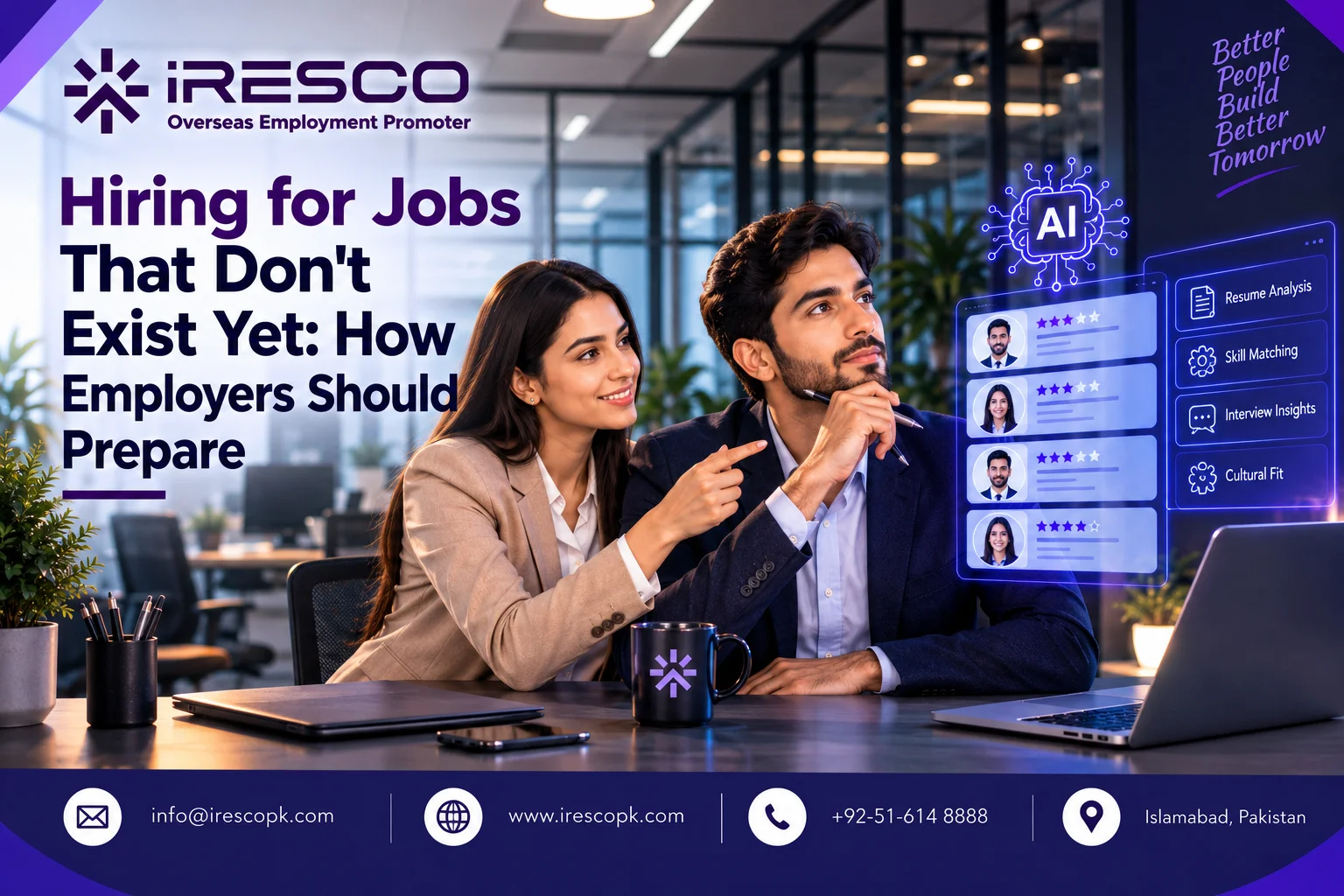
Artificial intelligence can help employers identify emerging skill requirements, analyze workforce trends, organize applications, and assess patterns in recruitment data. When used responsibly, these tools can improve planning and reduce repetitive administrative work.
For example, workforce analytics may help HR teams identify departments where retirements, turnover, or changing technology could create future skills shortages. AI-supported learning platforms can also recommend training based on an employee’s current capabilities and development goals.
Nevertheless, technology should support rather than replace responsible hiring decisions.
Automated recruitment systems can produce misleading results when their data is incomplete or their evaluation criteria favor particular backgrounds. Employers must ensure that candidate assessments remain relevant to the job and do not unfairly disadvantage applicants. For further insight, read IRESCO’s blog on AI and human expertise in recruitment.
Human oversight is especially important when evaluating transferable skills, career changes, nontraditional qualifications, and potential for growth. A candidate who lacks experience with a newly introduced tool may still possess the analytical ability and learning capacity required to master it.
Employers should establish clear policies for data privacy, candidate consent, algorithmic oversight, and the review of automated decisions. The purpose of AI should be to improve decision-making, not to create another barrier between qualified people and employment opportunities.
Develop a Culture of Continuous Learning
Hiring for future jobs cannot succeed through recruitment alone. Organizations must create an environment where employees are encouraged to learn, experiment, share knowledge, and adapt to changing responsibilities.
A company that recruits talented people but provides no opportunities for development may struggle to retain them. Conversely, organizations that support continuous learning can build a workforce capable of responding to new challenges without starting the recruitment process from scratch every time.
Managers play a central role in creating this environment. They should discuss career goals, identify skill gaps, recognize learning achievements, and give employees opportunities to apply newly acquired knowledge.
Businesses can strengthen this culture through internal learning programs, mentorship, cross-functional projects, professional certifications, and regular development reviews. For additional insights, explore IRESCO’s blog on the global race for skilled talent.
It is also important to reward the practical application of new skills. Employees should see a clear connection between learning, improved performance, career progression, and business outcomes.
Make Ethical Recruitment Part of Future Workforce Planning
As emerging industries compete for scarce skills, pressure to recruit quickly may increase. Employers must ensure that speed does not come at the expense of transparency, fairness, or worker protection.
This is particularly important when hiring internationally or working with third-party recruitment providers. Candidates should receive accurate information about their responsibilities, compensation, location, employment conditions, and any relevant relocation arrangements.
Employers should follow best practices for ethical international recruitment, including transparent communication, fair selection, responsible handling of candidate information, and appropriate safeguards against misleading job offers.
Recruitment providers should be assessed on their credentials, service quality, compliance practices, and ability to communicate clearly with candidates. Employers should also establish written agreements defining recruitment responsibilities, fees, documentation requirements, and reporting procedures.
Ethical recruitment is not simply a legal or reputational concern. It can improve candidate trust, reduce disputes, support retention, and strengthen an employer’s ability to attract skilled workers over the long term.
Create a Practical Roadmap for Future Hiring
Preparing for jobs that do not yet exist can seem complicated, especially for organizations with limited HR resources. A phased approach makes the process more manageable.
| Timeline | Priority | Key action |
|---|---|---|
| First 30 days | Assess | Review business plans, technology changes, and current workforce skills |
| Days 31 to 60 | Plan | Identify future roles, skills gaps, and training opportunities |
| Days 61 to 90 | Pilot | Test targeted training, revised job descriptions, or new recruitment methods |
| Ongoing | Improve | Monitor results and update workforce plans as business needs change |
Employers should measure progress using practical indicators such as time to fill critical positions, internal promotion rates, training completion, employee retention, and the percentage of emerging skill gaps addressed.
These measures help HR teams determine whether their approach is improving workforce readiness rather than simply increasing recruitment activity.
Conclusion
Hiring for jobs that do not exist yet requires employers to think beyond immediate vacancies. As technology, customer expectations, and industry requirements evolve, businesses must identify emerging skills, invest in employee development, and prepare recruitment strategies before talent shortages become urgent.
The most effective approach combines workforce planning, skills-based hiring, continuous learning, responsible AI adoption, and carefully managed international recruitment. Employers should also create transparent recruitment processes that help candidates understand their responsibilities and future opportunities. Building long-term workforce partnerships can also help organizations prepare for changing manpower requirements and establish a more strategic approach to recruitment.
Organizations cannot predict every role the future will create. However, they can build systems that make change easier to manage. By preparing employees, strengthening recruitment partnerships, and connecting talent decisions with long-term business goals, employers can create a workforce ready not only for today’s requirements but also for the opportunities that have yet to emerge.
Frequently Asked Questions (FAQs)
1. What does hiring for future jobs mean?
Hiring for future jobs means preparing to recruit employees for roles that may emerge as technology, automation, and business needs evolve. It involves identifying future skills, planning workforce requirements, and developing adaptable talent.
2. How can employers identify jobs that do not exist yet?
Employers can monitor technological developments, industry trends, changing customer needs, and internal skills gaps. Workforce planning helps them anticipate new responsibilities and prepare recruitment or training strategies before vacancies arise.
3. Why is skills-based hiring important for future workforce planning?
Skills-based hiring focuses on candidates’ abilities, transferable skills, and potential rather than relying only on job titles or formal qualifications. It helps employers identify adaptable candidates who can learn new technologies and grow into emerging roles.
4. Can international recruitment help employers fill future skills gaps?
Yes. International recruitment can help businesses access specialized talent that may be limited in their local labor markets. Employers must still verify qualifications, employment eligibility, work authorization, and compliance with applicable recruitment laws.
5. How can Pakistani employers recruit workers for overseas opportunities?
Pakistani employers and recruitment businesses should understand the relevant licensing requirements, verify recruitment providers, and ensure that job offers and employment documents are accurate. Candidates can also browse official overseas job listings and verify vacancy details before accepting an offer.
6. What should employers look for in an overseas recruitment agency?
Employers should check the agency’s credentials, relevant experience, candidate screening methods, documentation procedures, transparency, and compliance practices. Businesses using a government approved overseas employment promoter should verify its current licensing status through the appropriate official channels.
7. How can companies prepare employees for emerging roles?
Companies can offer upskilling, reskilling, mentoring, cross-functional assignments, and practical training. These initiatives help employees develop new capabilities and may reduce the need for external recruitment when business requirements change.
8. What role will AI play in future recruitment?
AI can support workforce forecasting, application management, skills analysis, and recruitment administration. However, employers should maintain human oversight, protect candidate data, and regularly review automated systems for accuracy and potential bias.
9. How can employers ensure ethical international recruitment?
Employers should communicate job responsibilities, salaries, working conditions, and contractual terms clearly. They should verify recruitment partners, protect candidate information, document relevant payments, and follow applicable labor and immigration requirements.
10. How often should businesses update their workforce plans?
Businesses should review workforce plans regularly and whenever significant changes occur in technology, market demand, business strategy, or regulations. A quarterly review can help organizations identify new skills gaps and adjust recruitment and training priorities.
