

The global workforce is changing rapidly, and businesses can no longer depend only on traditional local hiring methods to find the right people. Skills shortages, changing workforce expectations, expanding industries, and increasing demand for specialized professionals are encouraging employers to rethink how they build their teams. IRESCO (International Recruitment & Employment Search Company) helps businesses connect with qualified professionals through structured international recruitment and overseas employment solutions. Instead of treating recruitment as simply filling vacant positions, modern employers are increasingly developing long-term talent strategies designed around skills, workforce planning, business growth, and access to global talent.
A talent shortage can slow down projects, increase workloads for existing employees, delay expansion, and create additional recruitment costs. However, businesses that approach hiring strategically can turn workforce challenges into opportunities. By combining workforce planning, skills-based recruitment, technology, international talent acquisition, and reliable recruitment partnerships, employers can build teams that are better prepared for both current and future business requirements.
What Is a Talent Shortage?
A talent shortage occurs when businesses cannot find enough qualified candidates with the skills, experience, or professional capabilities required for available positions. The issue is not always a lack of people looking for jobs. In many cases, the challenge is a mismatch between the skills employers need and the skills available within their immediate labor market.
For example, a construction company may need experienced electricians, welders, engineers, technicians, project managers, or safety professionals. If enough qualified candidates are not available locally, vacancies can remain open for extended periods.
This can affect:
- Project timelines
- Business expansion
- Productivity
- Customer service
- Employee workload
- Operational costs
- Revenue opportunities
As industries become more specialized, businesses need to think beyond simply advertising vacancies. They need to develop a structured approach to finding, assessing, recruiting, and retaining the right talent.
Why Businesses Need to Rethink Traditional Hiring
Traditional recruitment often begins when a vacancy appears. A company publishes a job advertisement, waits for applications, conducts interviews, and selects a candidate. While this approach can work for certain positions, it can become challenging when the available local talent pool is limited.
Modern businesses increasingly need to ask different questions:
- What skills will we need six months from now?
- Which positions are difficult to fill locally?
- Can qualified talent be sourced internationally?
- Which skills are critical for future growth?
- How can recruitment time be reduced?
- How can employers improve candidate quality?
- How can international hiring remain compliant and organized?
These questions move recruitment from a short-term administrative activity toward strategic workforce planning. Instead of asking, “How quickly can we fill this vacancy?” businesses can ask, “What type of workforce do we need to achieve our long-term objectives?” That shift is at the heart of modern talent strategy.
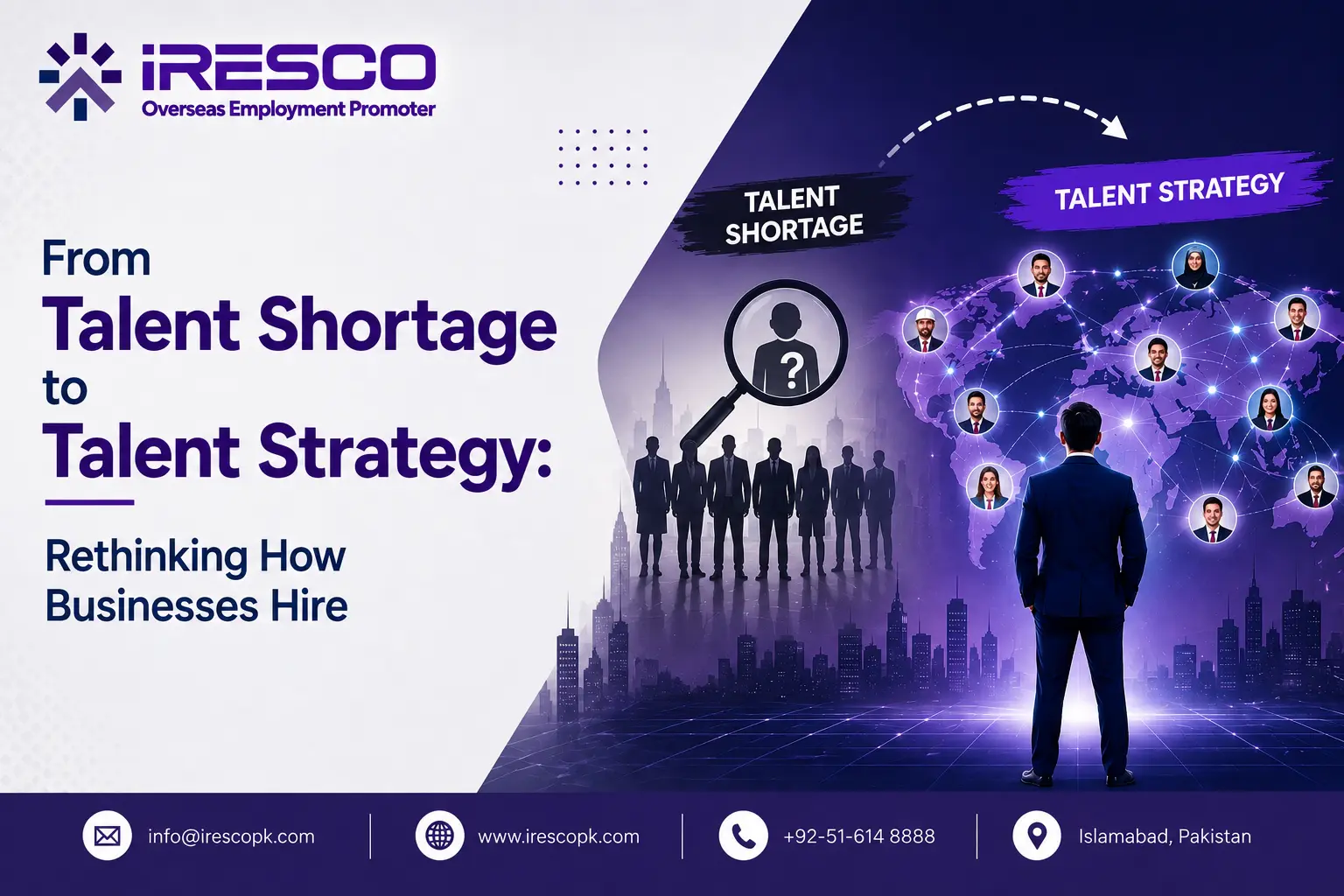
From Talent Shortage to Talent Strategy
A talent shortage does not necessarily mean that suitable professionals do not exist. Sometimes, businesses simply need access to a broader talent market. This is where international recruitment can become an important part of workforce planning. A global recruitment strategy allows employers to search beyond their immediate geographical area and identify professionals based on their skills, qualifications, experience, and suitability for specific positions.
For companies operating in sectors such as construction, healthcare, manufacturing, FMCG, oil and gas, hospitality, and other industrial fields, international recruitment can provide access to broader talent pools.
Instead of limiting recruitment to one city or country, employers can create a wider talent pipeline.
A Strategic Recruitment Approach Includes:
- Identifying current and future workforce requirements
- Defining the skills required for each position
- Understanding local and international talent availability
- Building reliable candidate pipelines
- Screening and evaluating candidates
- Managing recruitment documentation
- Supporting visa and employment processes where required
- Preparing candidates for deployment
- Monitoring workforce needs over time
This approach helps transform recruitment from a reactive process into a long-term business strategy.
Skills-First Recruitment Is Changing the Hiring Landscape
One of the most important developments in modern recruitment is the increasing focus on skills-first hiring. Traditional recruitment can sometimes place heavy emphasis on job titles, degrees, or previous employers. A skills-first approach looks more closely at what a candidate can actually do. For employers, this means identifying the specific capabilities required for a position before beginning the recruitment process.
For example, an employer searching for an industrial technician may need someone with:
- Equipment maintenance experience
- Technical troubleshooting skills
- Safety knowledge
- Industry certifications
- Practical field experience
- Ability to work with specific machinery
A skills-first recruitment strategy makes these requirements clear from the beginning. This can help employers create more accurate job descriptions and improve the process of candidate evaluation.
International Recruitment Expands Access to Talent
When local recruitment does not provide enough suitable candidates, international recruitment agencies can help employers explore wider talent markets.
Pakistan, for example, has a large workforce with professionals and skilled workers across multiple industries. International employers may seek Pakistani candidates for positions requiring technical skills, professional qualifications, trade experience, and specialized expertise. For employers, international recruitment can create access to candidates who may not otherwise be visible through local recruitment channels.
The process can include candidate sourcing, screening, interviews, documentation, employment coordination, and deployment support. A structured recruitment partner can also help employers navigate the practical requirements associated with overseas employment and international hiring.
Why Workforce Planning Matters More Than Ever
Recruitment should not begin only after a position becomes vacant. Effective workforce planning considers future requirements before they become urgent problems.
For example, a company planning to expand its manufacturing capacity may know months in advance that it will require additional technicians, operators, engineers, supervisors, and support staff.
Instead of waiting until the expansion begins, the business can start building its talent pipeline earlier.
This creates more time for:
- Candidate sourcing
- Skills assessment
- Interviews
- Documentation
- Employment processing
- Visa processing
- Travel arrangements
- Orientation
Early planning can make international hiring more organized and reduce the pressure associated with last-minute recruitment.
The Role of Recruitment Agencies in Modern Talent Strategy
A professional overseas recruitment agency can become an extension of an employer’s workforce strategy. Rather than simply forwarding CVs, a recruitment partner can help employers manage several stages of the hiring process.
Depending on the recruitment requirement, these services may include:
Candidate Sourcing
Recruitment agencies can search for candidates through established talent networks and recruitment channels.
Candidate Screening
Candidates can be assessed according to qualifications, experience, technical capabilities, and job requirements.
Interview Coordination
Employers can participate in structured interviews to evaluate candidates before making hiring decisions.
Documentation Support
International employment involves documentation and administrative requirements. Proper coordination can help organize the recruitment process.
Visa and Deployment Support
Where applicable, recruitment partners can assist with processes connected to visa documentation, employment processing, and candidate deployment.
For employers recruiting from Pakistan, IRESCO provides overseas employment and recruitment services designed to connect businesses with professionals and skilled workers for international opportunities.
Technology Is Transforming Talent Acquisition
Technology is also changing how businesses approach recruitment. Modern recruitment processes can use digital platforms, applicant tracking systems, data analysis, video interviews, automated screening, and AI-supported tools to improve efficiency. However, technology should support recruitment professionals rather than completely replace human judgment.
A candidate’s CV may show qualifications, but employers may also need to understand:
- Practical experience
- Communication ability
- Cultural adaptability
- Professional attitude
- Technical competence
- Career goals
- Position suitability
The future of recruitment is therefore likely to combine technology with human expertise. For international hiring, this combination can make it easier to identify candidates while maintaining a human-centered evaluation process.
Building a Reliable Global Talent Pipeline
A single successful hire does not necessarily solve a company’s long-term workforce challenge. Businesses that regularly recruit international workers can benefit from building a global talent pipeline. A talent pipeline means maintaining access to potential candidates who may be suitable for current or future positions.
For example, an employer may currently require 20 technicians but expect to need another 30 workers during the next phase of expansion.
Rather than beginning recruitment from zero every time, the company can maintain a structured talent pipeline.
This approach can support:
- Faster recruitment
- Better workforce forecasting
- Improved candidate access
- More consistent hiring
- Easier expansion
- Reduced recruitment disruption
International Hiring Can Support Business Expansion
Workforce availability can influence how quickly a company expands. A business may have the capital, projects, equipment, and customers necessary for growth but still struggle to expand because it cannot find enough qualified workers. International recruitment can become part of the solution by helping employers access talent from other countries.
For businesses operating in the Middle East and other international markets, access to skilled and semi-skilled workers can be particularly important across construction, healthcare, hospitality, manufacturing, oil and gas, FMCG, and industrial sectors.
A broader workforce strategy allows companies to consider talent availability as part of their overall expansion planning.
Recruitment Quality Matters as Much as Recruitment Speed
Fast hiring can be useful, but speed alone should not determine recruitment success.
Hiring an unsuitable candidate can create additional costs through:
- Repeated recruitment
- Training expenses
- Productivity loss
- Project delays
- Employee replacement
- Administrative work
This is why modern international talent acquisition should balance speed with quality. A strong recruitment strategy considers whether candidates genuinely match the employer’s requirements. The objective should not simply be to fill positions quickly. It should be to connect the right skills with the right positions.
Compliance Is an Essential Part of International Recruitment
Cross-border recruitment involves more than identifying candidates. Employers and recruitment partners may need to manage employment documentation, contracts, visa-related requirements, regulatory procedures, and other administrative processes. Compliance should therefore be incorporated into the recruitment strategy from the beginning.
For employers recruiting workers from Pakistan, working with an established overseas employment partner can help create a more organized recruitment process. IRESCO operates as an Overseas Employment Promoter and supports international recruitment requirements for employers seeking Pakistani professionals and skilled workers.
How Employers Can Create a Future-Ready Talent Strategy
Businesses can take several practical steps to move from reactive recruitment toward strategic hiring.
1. Identify Critical Skills
Determine which skills are essential for current operations and future growth.
2. Analyze Talent Gaps
Identify positions where local recruitment is consistently difficult or where qualified candidates are limited.
3. Expand Recruitment Markets
Consider international recruitment when suitable talent is not sufficiently available locally.
4. Build Candidate Pipelines
Maintain relationships with potential candidates rather than recruiting only when vacancies become urgent.
5. Use Technology
Use recruitment technology to improve candidate sourcing, communication, screening, and organization.
6. Maintain Human Evaluation
Technology can support recruitment, but professional human assessment remains important.
7. Plan International Hiring Early
Allow sufficient time for candidate selection, documentation, visa processing, and deployment.
8. Work With a Reliable Recruitment Partner
An experienced recruitment agency can help coordinate multiple stages of international hiring.
Why Pakistani Talent Can Be Part of a Global Workforce Strategy
Pakistan has a large and diverse workforce spanning professional, technical, skilled, and semi-skilled occupations. International employers seeking workforce solutions may consider Pakistani candidates for a range of roles depending on their specific qualifications and requirements. A structured Pakistan overseas recruitment process can help employers connect with suitable candidates while managing the practical requirements of international employment.
For Pakistani professionals and skilled workers, international recruitment also creates pathways to employment opportunities across global markets.
This creates a connection between two important needs: employers looking for skills and workers seeking international career opportunities.
The Future of International Recruitment
The future of recruitment will likely be increasingly global, technology-enabled, skills-focused, and strategic. Businesses will continue to face changing workforce requirements as industries develop, new technologies emerge, and labor markets evolve. This means recruitment departments may need to move beyond traditional vacancy filling.
The modern recruitment function can become a strategic business partner responsible for helping organizations understand:
- Which skills they need
- Where those skills can be found
- How quickly they can be accessed
- How talent can be evaluated
- How international hiring can be managed
- How workforce requirements may change in the future
For employers facing talent shortages, the answer may not always be to compete harder for the same local candidates. Sometimes, the opportunity lies in expanding the search and building a broader global talent strategy.
How IRESCO Supports International Workforce Solutions
IRESCO supports employers looking to recruit qualified Pakistani professionals, skilled workers, and semi-skilled workers for international employment opportunities.
With its recruitment operations and overseas employment expertise, IRESCO works across sectors including FMCG, healthcare, oil and gas, construction, and industrial sectors.
The organization supports recruitment requirements for destinations including Saudi Arabia, the UAE, Algeria, Bahrain, and other international markets.
For employers, the objective is to create a structured connection between workforce requirements and available talent.
For candidates, international recruitment provides access to employment opportunities beyond their domestic labor market.
This employer-and-candidate connection is an important part of the modern global workforce.
Conclusion
The shift from talent shortage to talent strategy represents a broader change in how businesses think about hiring. Recruitment is no longer simply about filling an empty position. For organizations operating in competitive markets, workforce planning, skills identification, international recruitment, technology, compliance, and long-term talent pipelines can all become important parts of business strategy.
When local talent pools cannot fully meet workforce requirements, international recruitment can give employers access to a wider range of skills and experience. By planning ahead and working with reliable recruitment partners, businesses can build workforce strategies that support both immediate operational requirements and future growth.
The future belongs to organizations that understand where their talent needs are heading and prepare for them before shortages become barriers. International recruitment and strategic workforce planning can help businesses move from reacting to talent shortages toward building a workforce prepared for what comes next.
Frequently Asked Questions (FAQs)
1. What is a talent strategy?
A talent strategy is a long-term approach to attracting, recruiting, developing, and retaining the people and skills a business needs to achieve its goals. It goes beyond filling individual vacancies and considers future workforce requirements.
2. How can international recruitment help with talent shortages?
International recruitment allows employers to access talent beyond their local labor market. This can be useful when businesses have difficulty finding candidates with specific technical skills, professional qualifications, or industry experience locally.
3. Why is skills-first recruitment becoming important?
Skills-first recruitment focuses on the actual abilities and experience required for a position rather than relying only on job titles or traditional qualifications. It can help employers identify candidates based on their suitability for specific roles.
4. What does an overseas recruitment agency do?
An overseas recruitment agency can support employers with candidate sourcing, screening, interviews, documentation, employment coordination, and other stages of international recruitment, depending on the recruitment requirements and applicable regulations.
5. Why should businesses plan international recruitment in advance?
International recruitment can involve candidate selection, documentation, employment processing, visa-related procedures, and deployment arrangements. Planning ahead gives employers more time to complete these steps and build a suitable workforce pipeline.
