

Imagine a skilled professional arriving in a new country with years of experience, recognized qualifications, and a strong employment history, only to discover that their degree or certificate does not meet local job requirements. Despite having the right knowledge and practical abilities, they may face delays, additional assessments, or rejection during the hiring process.
This situation is common in international recruitment. Qualifications that are accepted in one country may not automatically satisfy the requirements of another. Differences in education systems, licensing rules, professional standards, and industry expectations can create challenges for both employers and foreign workers.
For employers, the problem is finding qualified people without compromising workplace standards. For candidates, it is understanding how their existing education and experience will be evaluated abroad. Working with a reliable international recruitment partner can help employers navigate international hiring requirements and support candidates through the recruitment process.
The solution is not always to reject a candidate or ask them to start their education again. Employers and recruitment professionals should first understand the reason for the mismatch and identify practical ways to assess the candidate fairly.
Why Foreign Qualifications May Not Meet Local Requirements
Educational systems vary from country to country. A bachelor’s degree, technical diploma, or vocational certificate may involve different study periods, course content, practical training, and assessment methods.
As a result, employers and regulatory bodies may not consider two qualifications equivalent, even when their titles appear similar.
Several factors can contribute to this issue.
- Different education standards: Courses with similar names may cover different subjects or levels of technical knowledge.
- Unrecognized institutions: A qualification may come from an institution that is not recognized by the relevant authority in the destination country.
- Missing practical training: Some occupations require supervised practice, workplace training, or a specific number of practical hours.
- Different professional regulations: Certain professions require local registration, examinations, or a license before a person can work legally.
- Incomplete documentation: Missing transcripts, experience letters, verified certificates, or translations can delay the assessment process.
Understanding the exact reason for the mismatch helps employers decide what steps are necessary before making a hiring decision. For further insight into how skills are valued across international markets, read IRESCO’s blog on the global skills economy.
Understand the Difference Between Skills and Formal Recognition
One of the biggest mistakes in international hiring is assuming that a qualification mismatch automatically means a candidate lacks the required skills.
A worker may have extensive experience operating machinery, managing construction projects, maintaining electrical systems, or working in healthcare. However, the destination country’s employer or regulator may require a particular certificate or professional registration.
These are two different questions: Can the candidate perform the job, and are they formally eligible to perform it under local rules?
Employers should evaluate both. To understand why practical abilities and transferable skills matter in global hiring, explore IRESCO’s blog on recruiting multi-skilled Pakistani workers.
For roles that do not require a regulated license, relevant experience, practical tests, work samples, and competency-based interviews may help establish whether a candidate can perform the job. For regulated occupations, however, practical ability does not replace mandatory licensing or recognition requirements.
A fair recruitment process identifies these differences early and gives candidates clear information about what they must provide or complete.
How Employers Can Verify Foreign Qualifications
Employers should establish a consistent verification process before making final hiring decisions. This reduces delays and helps prevent unsuitable placements.
1. Check the Destination Country’s Requirements
The first step is to identify the applicable rules for the specific occupation and country. Requirements may differ between professions, employers, and regulatory authorities.
Employers should confirm whether the position requires a recognized degree, professional registration, a local license, or a particular technical certification. DITRC’s guide on overseas recruitment requirements can provide additional context on the overseas recruitment process and the importance of understanding job requirements.
They should also distinguish between requirements established by law and additional qualifications preferred by the employer.
2. Verify Documents Through Appropriate Channels
Candidates may need to provide original certificates, academic transcripts, training records, professional licenses, and experience letters.
Depending on the destination country and occupation, documents may require authentication, official verification, certified translation, or assessment by an authorized qualifications body. Reviewing a candidate’s background carefully is also important, and DITRC explains this process in its article on preventing qualification fraud.
Employers should communicate these requirements before recruitment is finalized. They should never rely only on a candidate’s résumé or a photocopy of a certificate when formal verification is necessary.
3. Assess Relevant Work Experience
Formal education is only one part of a candidate’s professional background. Previous responsibilities, technical knowledge, practical achievements, and industry experience can provide useful evidence of competence. This is why skills-based recruitment strategies can help employers look beyond formal qualifications when evaluating candidates.
For example, an experienced industrial technician may have developed strong troubleshooting skills through years of hands-on work. A practical assessment can help determine whether those skills meet the employer’s job requirements, provided all mandatory certification and licensing rules are satisfied.
4. Explain Any Gaps Clearly
Candidates should receive clear information if their qualifications do not meet the required standard. Employers should explain which document, assessment, training course, or authorization is missing.
This allows candidates to make informed decisions instead of spending time and money on a recruitment process that may not lead to employment.
The Role of Recruitment Agencies in Qualification Assessment
International recruitment involves more than matching résumés with job vacancies. Recruitment professionals must understand employer requirements, candidate documentation, and the rules that apply in the destination country. Understanding international recruitment partnerships can help employers learn how businesses connect with suitable talent across borders.
A reliable recruiting agency in Pakistan can help employers and candidates organize documentation, identify potential qualification gaps, and understand the next steps in the recruitment process. However, the agency’s role should not be confused with the authority to formally recognize a degree or grant a professional license.
Employers should confirm that the recruitment partner understands the requirements for the relevant occupation and destination market.
When hiring from Pakistan, businesses should also verify the recruiter’s current licensing and authorization through the appropriate official channels. Working with a government approved overseas employment promoter, where applicable, can support a more accountable recruitment process, but it does not remove the need to verify individual qualifications or comply with destination-country regulations.
The objective should be to identify problems before a candidate travels, signs a final employment arrangement, or begins work.
Preparing Candidates for Gulf Country Requirements
Gulf countries attract workers from Pakistan across construction, engineering, healthcare, hospitality, manufacturing, transportation, and other industries. However, qualification and licensing requirements can vary by country, occupation, and employer.
Employers should not assume that a certificate accepted in one Gulf country will automatically be accepted in another.
For this reason, recruitment agencies in Pakistan for Gulf countries should help candidates understand the specific requirements of the intended destination before the recruitment process advances too far. Understanding overseas recruitment procedures can help employers and candidates prepare for the requirements involved in international hiring.
A practical preparation process may include:
- Confirming the exact job title and minimum qualification requirements.
- Checking whether professional registration or a local license is mandatory.
- Identifying the documents that need authentication or translation.
- Confirming whether an examination, competency test, or additional training is required.
- Explaining the expected costs, timelines, and responsibilities before the candidate proceeds.
This preparation is especially important when recruiting workers in large numbers. If qualification issues are discovered only after deployment, employers may face delays, additional expenses, staffing shortages, and avoidable disputes.
Managing Qualification Gaps During Bulk Recruitment
Large recruitment campaigns require a clear and repeatable process for evaluating candidates. When hundreds of workers are being recruited for similar positions, inconsistent document checks can lead to errors and delays.
Employers using bulk manpower recruitment services should establish qualification criteria before applications are collected.
These criteria should specify the required education level, acceptable certifications, minimum experience, mandatory licenses, and any additional assessments.
Recruitment teams can then classify applicants according to their eligibility:
- Ready for assessment: Candidates whose documents appear complete and who meet the stated initial requirements.
- Pending verification: Candidates whose qualifications or supporting documents require confirmation.
- Additional requirements needed: Candidates who may qualify after completing a required assessment, training program, or licensing step.
- Not eligible for the role: Candidates who do not meet mandatory requirements and cannot satisfy them within the relevant process.
This approach helps employers avoid treating every qualification mismatch as the same problem.
It also supports better workforce planning because HR teams can estimate how many candidates are ready for placement and how many may need further preparation.
How Employers Can Help Qualified Candidates Overcome Gaps
When a candidate has relevant skills but lacks a specific non-mandatory qualification, employers may be able to offer alternative pathways.
Depending on the occupation and applicable rules, these could include additional technical training, competency assessments, supervised experience, or support in obtaining a recognized certification.
Employers can also work with training providers to prepare candidates for particular equipment, industry standards, or workplace procedures. Investing in workforce skills development can help businesses address skill gaps and prepare employees for changing job requirements.
However, these options must be realistic. A short training course cannot replace a legally required professional license, and an employer should never promise that a qualification will be accepted before the relevant authority confirms it.
Clear communication is essential. Candidates should understand which requirements are compulsory, which are employer preferences, and which gaps can potentially be addressed through further training.
Choosing the Right International Recruitment Partner
A capable recruitment partner should help employers plan for qualification verification instead of treating it as a final administrative task.
Before starting a recruitment campaign, businesses should discuss job specifications, destination-country requirements, document verification procedures, candidate screening methods, and expected timelines.
Employers looking for structured support can explore our international recruitment services to learn more about international candidate sourcing and recruitment support.
The most suitable recruitment process is one that balances speed with accuracy. Filling vacancies quickly is important, but sending candidates whose qualifications do not meet mandatory requirements can create more serious problems later.
Conclusion
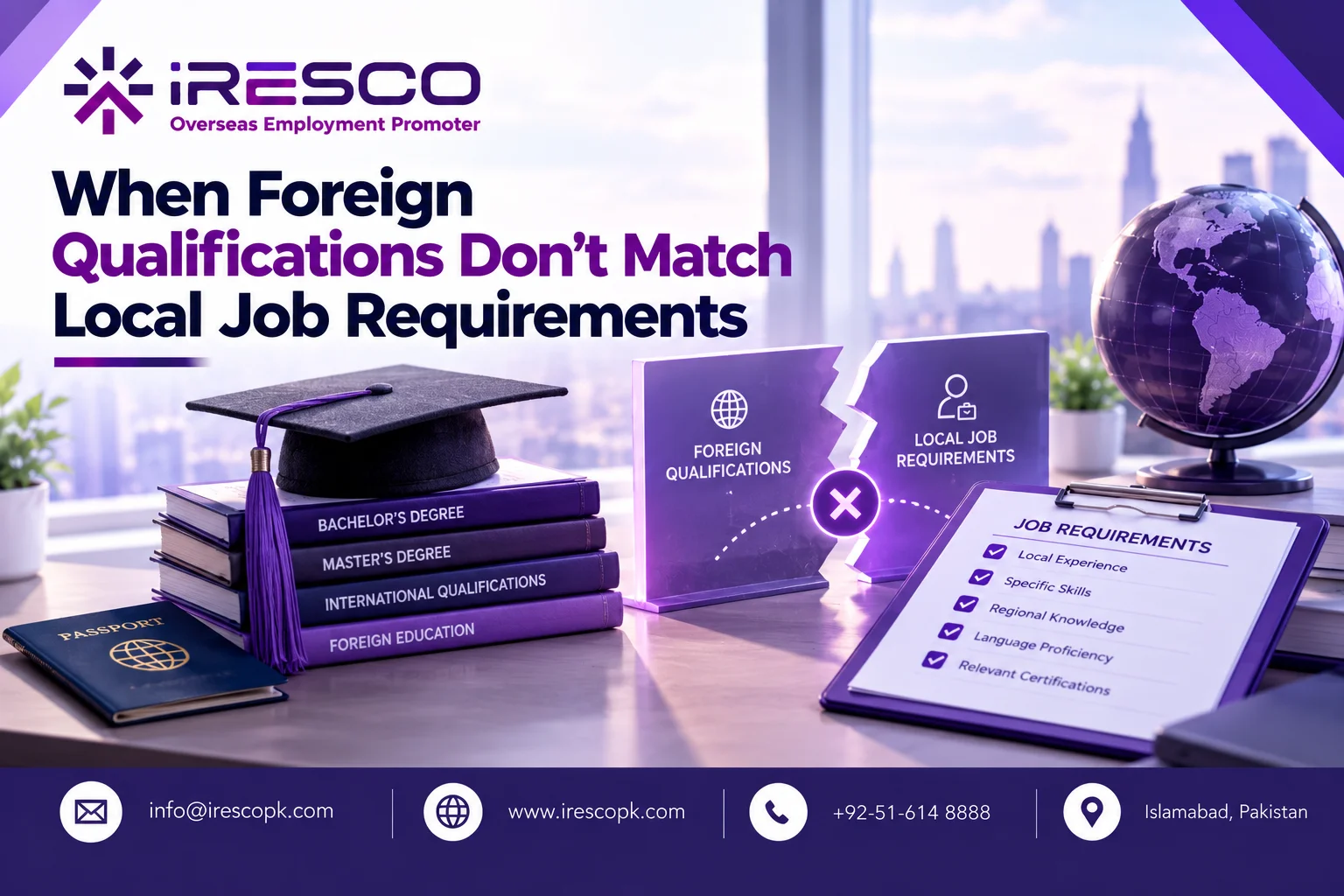
When foreign qualifications do not match local job requirements, employers should investigate the gap before rejecting a candidate or proceeding with recruitment. Differences in education systems, licensing standards, documentation, and professional regulations can all affect eligibility.
A structured process helps employers verify credentials, assess practical skills, identify additional requirements, and communicate decisions clearly. Recruitment agencies can support this process by helping candidates prepare documents and understand destination-country expectations, while formal recognition and licensing remain the responsibility of the relevant authorities. Employers can also explore international recruitment services to understand how overseas candidate sourcing and recruitment support can assist their hiring plans.
For employers recruiting internationally, the key is early verification. By addressing qualification issues before hiring and deployment, businesses can reduce delays, protect compliance, and make better use of the skills available in the global workforce.
Frequently Asked Questions(FAQs)
1. Why might a foreign degree not be accepted in another country?
The destination country may have different education standards, recognition rules, licensing requirements, or documentation procedures. The relevant authority must determine whether the qualification meets the applicable criteria.
2. Can employers hire candidates whose foreign qualifications are not fully recognized?
It depends on the role and local regulations. Some positions may allow skills-based assessment, while regulated professions may require formal recognition, registration, or a license before employment.
3. How can Pakistani workers prepare their qualifications for overseas employment?
Workers should check the destination country’s requirements, gather certificates and transcripts, verify whether authentication or translation is needed, and confirm any examination or licensing requirements before accepting an offer.
4. How do recruitment agencies help with qualification mismatches?
Recruitment agencies can help communicate job requirements, organize documents, identify potential gaps, and coordinate screening. They cannot independently grant formal recognition or override licensing rules.
5. Why is qualification verification important in bulk recruitment?
Verifying qualifications early helps employers identify eligible candidates, avoid preventable deployment delays, manage recruitment costs, and ensure workers meet the requirements of their intended positions.
