
Artificial intelligence has changed the way people search and apply for jobs. Candidates can now use AI tools to write professional CVs, prepare cover letters, answer application questions, and even improve their interview preparation. While these tools can save time and improve communication, they have also created new challenges for employers trying to identify genuine talent.
In 2026, recruiters are receiving applications that look more polished than ever. However, a professionally written CV does not necessarily represent a candidate’s actual experience, technical knowledge, or communication skills. Some applicants use AI to explain their real achievements, while others rely on it to create qualifications, responsibilities, and professional experiences they do not possess. For employers, following ethical and effective recruitment practices is essential to identifying genuine talent and making informed hiring decisions.
This has encouraged employers to introduce more detailed screening methods. Instead of relying entirely on the appearance of a CV, hiring teams are paying closer attention to application quality, employment history, interview responses, practical assessments, and background verification.
Understanding how employers detect AI-generated job applications can help recruitment professionals improve their screening processes while allowing genuine candidates to use modern technology responsibly.
Why AI-Generated Job Applications Are Increasing in 2026
The growing use of AI in recruitment is not limited to employers. Job seekers are also using these tools to compete in an increasingly demanding employment market. Preparing multiple applications can be time-consuming, particularly when candidates are applying for positions across different companies, industries, or countries.
AI tools make this process faster by helping applicants:
- Write and improve CVs and professional summaries.
- Create cover letters for specific job vacancies.
- Identify relevant keywords from job descriptions.
- Prepare answers to common application questions.
- Improve grammar, sentence structure, and overall presentation.
Modern recruitment is also changing through technology, as explained in this guide to AI in overseas recruitment.
According to a Gartner survey published in 2025, 39% of surveyed job candidates had used AI during the application process. Among those candidates, 54% used it to generate CV or résumé text, while 50% used it for cover letters. These figures demonstrate how widely AI assistance has become integrated into modern job searching.
However, there is an important difference between using AI to improve an application and allowing it to represent qualifications or experience that a candidate does not actually possess.
Employers are not necessarily concerned about every application that receives AI assistance. Their main concern is whether the information is accurate and whether the applicant can demonstrate the abilities described in their documents.
How Employers Detect AI-Generated Job Applications
Recruiters rarely depend on a single method to determine whether an application has been generated or heavily assisted by AI. Instead, they examine different elements of the application and compare the information with what the candidate demonstrates during the hiring process.
Generic Language and Repeated Expressions
One of the first things experienced recruiters may notice is generic writing. AI-generated applications often contain professional-sounding statements that could apply to almost any candidate.
Expressions such as “results-driven professional”, “excellent communication skills”, and “proven ability to deliver outstanding results” are common examples. These phrases are not automatically suspicious, but they provide little information about what an applicant has actually achieved.
For example, a candidate might describe themselves as an experienced project manager with strong leadership abilities. However, the CV may not explain which projects they managed, how many people they supervised, or what results they achieved. This is why hiring skilled workers from Pakistan requires proper evaluation of qualifications, professional experience, and actual job-related abilities.
Recruiters look for meaningful details rather than impressive language. Applications that contain specific responsibilities, measurable achievements, and relevant professional examples provide a clearer picture of a candidate’s background.
Inconsistencies Between the CV and Job Application
Another important screening method involves comparing different sections of an application.
Candidates sometimes use AI to prepare their CVs, cover letters, and application responses separately. If they do not review the information carefully, these documents may contain conflicting details.
For example, a CV might describe five years of experience in a particular industry, while the cover letter suggests only three years. Similarly, an applicant may mention managing a team in one document but describe themselves as an individual contributor elsewhere. Employers can also review employment history and candidate documents to identify inconsistencies before proceeding with recruitment.
Recruiters also examine employment dates, job titles, responsibilities, qualifications, and career progression.
Such inconsistencies do not automatically prove AI involvement. However, they can indicate that an application needs further clarification before the candidate moves to the next recruitment stage.
Unrealistic Skills and Achievements
AI can produce convincing professional statements, but it cannot make an applicant genuinely qualified for a position.
Some candidates include technical skills, management responsibilities, software knowledge, or industry experience that they cannot demonstrate when questioned.
For instance, an applicant applying for an IT position may list several programming languages and development tools without having practical experience using them. Another candidate may claim to have managed international recruitment operations but struggle to explain basic recruitment procedures.
Employers therefore examine whether the skills mentioned in an application match the candidate’s actual knowledge. This is where AI-powered candidate screening can support recruiters in evaluating qualifications, technical abilities, and relevant experience.
They may ask applicants to explain how they used a particular tool, describe a challenging project, or provide examples of problems they solved in previous roles.
Writing Style and Unnatural Professional Language
Recruiters may also notice unusual differences in writing style.
An application might contain highly polished sentences, complex vocabulary, and consistently structured paragraphs, while the candidate’s later communication is considerably different.
For example, a cover letter may sound extremely formal, but the applicant may struggle to explain its contents during an interview.
However, writing style should never be treated as conclusive evidence of AI use. Candidates may receive assistance from professional writers, grammar tools, or career advisers. Applicants who communicate in English as a second language may also have different writing patterns. As explained in this guide to AI and human recruitment, human evaluation remains important when assessing communication skills and candidate suitability.
The more useful approach is to assess whether the candidate understands and can support the information presented in their application.
The Role of AI Detection Tools and Applicant Tracking Systems
Technology is becoming an important part of modern recruitment, but employers should understand the difference between applicant tracking systems and AI-writing detection tools.
Can Applicant Tracking Systems Detect AI-Written CVs?
Applicant Tracking Systems (ATS) help employers manage large numbers of applications. These systems can extract information from CVs, organize candidate profiles, identify relevant qualifications, and help recruiters compare applications against job requirements.
Some platforms also offer AI-powered features that support candidate matching and recruitment workflows. Employers can also explore e-recruitment solutions to understand how digital platforms support application tracking, remote interviews, and recruitment management.
However, an ATS should not automatically be considered an AI-authorship detector. Its primary purpose is to organize and evaluate candidate information, not necessarily to determine whether a person used ChatGPT or another writing assistant.
Employers should therefore avoid assuming that a CV has been verified simply because it has passed an automated screening process.
How AI Content Detectors Are Used
Some organizations may use specialized AI detection software to examine written application responses. These tools analyze writing patterns and estimate whether content resembles text generated by artificial intelligence.
However, their results are not always reliable. Recruitment technology can support hiring decisions, but automated tools should be used carefully.
A detector may incorrectly flag human-written content or fail to identify text that has been edited after being generated by AI. This creates a risk of rejecting genuine candidates based on an uncertain result.
Employers should treat detection scores as possible indicators rather than final evidence. A more reliable decision requires reviewing the application, discussing relevant experience, and verifying the information provided.
How Interviews Help Employers Verify Genuine Skills
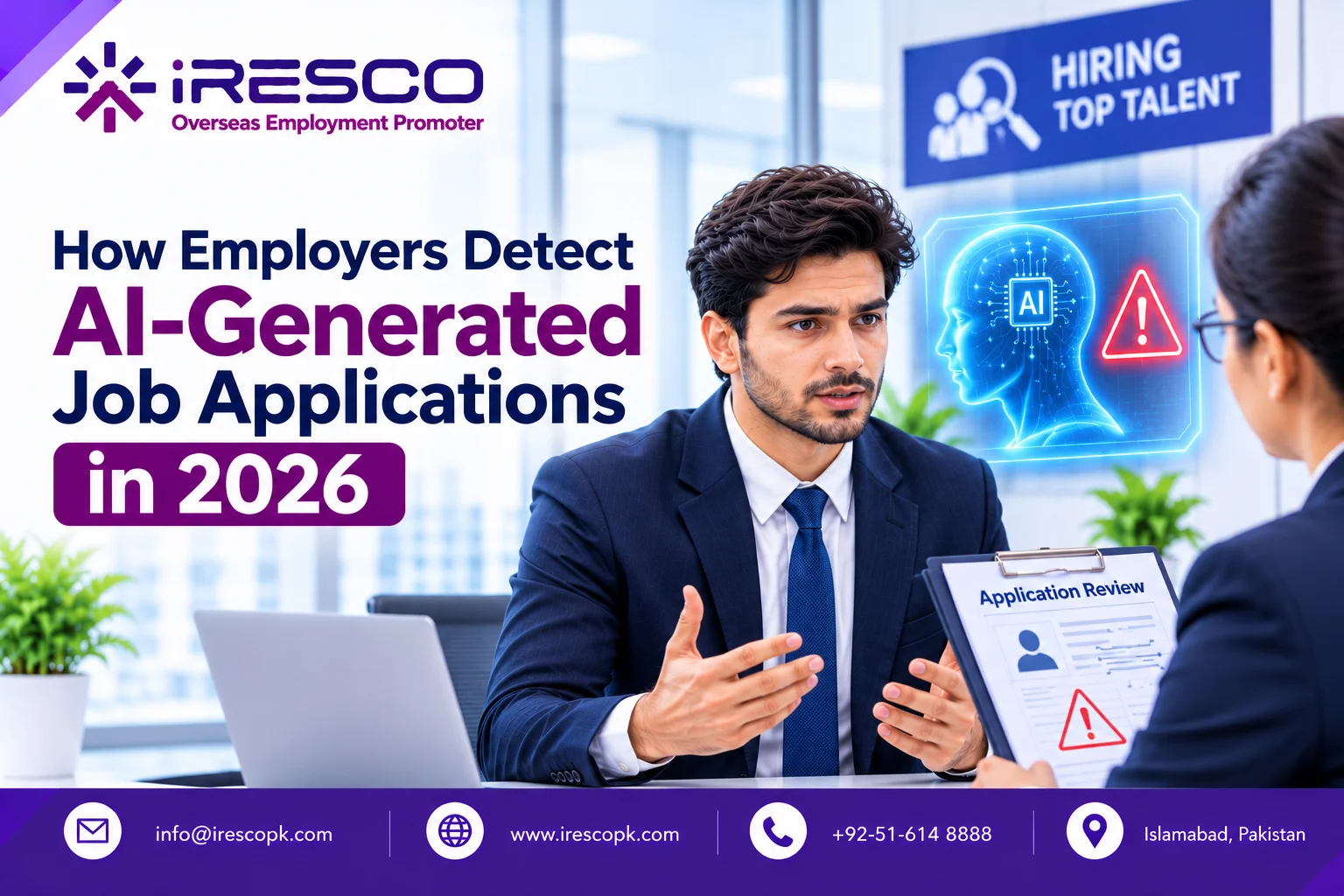
An interview remains one of the most useful opportunities to establish whether a candidate understands their own application.
A CV can describe responsibilities and achievements, but a conversation allows recruiters to explore the details behind those claims.
Asking Questions About Specific Work Experience
Recruiters can ask candidates to explain particular projects, responsibilities, and workplace challenges mentioned in their CVs.
For example, instead of simply asking whether someone has experience managing a team, an interviewer might ask:
- How many employees did you supervise?
- What responsibilities did you handle?
- What challenges did your team experience?
- How did you measure performance?
- Can you describe a difficult decision you made?
Candidates with genuine experience are generally better positioned to explain the practical details of their work.
These questions also help employers distinguish between someone who understands a subject and someone who has simply included relevant terminology in an application.
Evaluating Communication and Subject Knowledge
Employers may compare the candidate’s written responses with their ability to explain ideas verbally.
This does not mean that every candidate must speak perfect English or communicate in a particular style. Language ability should be assessed according to the actual requirements of the position. Through international recruitment services, employers can benefit from structured candidate screening and professional evaluation.
The objective is to understand whether applicants can communicate essential information, explain their decisions, and demonstrate the knowledge expected for the role.
A candidate who uses AI to improve their written English may still be fully capable of performing the job. Recruiters should focus on relevant competencies rather than treating polished writing as suspicious.
Using Practical Assessments
Practical assessments provide another way to verify a candidate’s abilities.
Depending on the position, employers may ask applicants to complete a technical task, prepare a short presentation, solve a workplace problem, or demonstrate how they would handle a realistic situation.
For example, an accounting candidate might be asked to review a financial statement, while a graphic designer could be asked to explain the decisions behind a portfolio project.
These exercises allow recruiters to evaluate actual performance instead of relying entirely on written claims.
Employers should establish clear assessment rules, including whether AI tools are permitted. This is particularly important for positions where using AI effectively is itself a valuable professional skill.
Background Verification and Document Checks
AI-generated applications can contain convincing descriptions of professional experience, but employment history and qualifications still need to be verified. Employers may use candidate background checks to confirm the accuracy of information provided during the hiring process.
Employers may contact previous organizations, check educational records, confirm professional certifications, and review references where appropriate.
For international recruitment, document verification can be particularly important because candidates may apply from different countries and have qualifications issued by different institutions.
A structured verification process can help employers confirm:
- Previous employment and job responsibilities.
- Educational qualifications and professional certificates.
- Relevant licenses and technical credentials.
- Employment dates and career history.
- References and other information supplied by candidates.
These checks are not specifically designed to detect AI writing. Instead, they help establish whether the claims made in an application are accurate.
This distinction matters because a human-written application can also contain false information, while an AI-assisted application can be completely truthful.
Why Employers Should Not Automatically Reject AI-Assisted Applications
Although AI-generated content can create recruitment challenges, employers should not assume that using AI makes someone an unsuitable candidate.
Many professionals use digital tools to improve their writing, organize information, and communicate more effectively. Rejecting applicants simply because their documents appear polished could exclude qualified individuals.
There is also a risk of unfair screening when employers rely too heavily on AI detection software. Research published by Stanford University in 2023 highlighted how AI detectors could incorrectly classify writing by non-native English speakers as AI-generated. <Cite refs={[“turn316571search1″,”turn316571search10”]}/>
A fair recruitment process should focus on relevant qualifications, practical experience, job-related skills, and verified information.
Employers should also communicate their expectations clearly. If candidates are allowed to use AI for grammar correction but not for completing independent assessments, those rules should be explained before the application process begins.
The purpose of screening is to identify capable and honest professionals, not to penalize candidates for using ordinary writing assistance.
How Recruitment Agencies Can Identify Genuine Candidates
Recruitment agencies play an important role in connecting employers with suitable professionals. As AI-assisted applications become more common, agencies need structured screening procedures that go beyond reviewing CVs.
An effective recruitment process begins with understanding the employer’s requirements. Recruiters should identify the essential qualifications, experience, technical knowledge, and communication abilities needed for each vacancy.
They can then compare applications against these requirements and investigate claims that need clarification.
Experienced recruitment professionals can also conduct preliminary interviews, review supporting documents, check employment history, and assess whether candidates are suitable for the available positions.
For overseas hiring, this process becomes even more important because employers may be recruiting workers from different professional and geographical backgrounds.
Following best practices for ethical international recruitment can help maintain transparency, support responsible candidate screening, and ensure that recruitment decisions are based on genuine qualifications.
A combination of technology and human judgement allows recruitment agencies to improve efficiency without losing sight of the people behind each application.
How Candidates Can Use AI Without Damaging Their Job Applications
AI can be a useful career tool when applicants use it responsibly. Candidates do not necessarily need to avoid AI altogether. Instead, they should make sure that every statement in their application accurately represents their experience.
Some practical recommendations include:
- Use AI for improvement: Ask AI to correct grammar, improve sentence structure, or organize information.
- Provide genuine details: Include actual responsibilities, achievements, qualifications, and employment history.
- Avoid fabricated experience: Never add skills, certificates, or professional achievements that you cannot verify.
- Review every document: Check that your CV, cover letter, and application answers contain consistent information.
- Prepare for interviews: Be ready to explain every important statement included in your application.
- Follow employer instructions: Respect any rules concerning AI assistance, assessments, and independent work.
The most effective application is not necessarily the one with the most sophisticated language. It is the one that communicates a candidate’s real abilities clearly and honestly.
Conclusion
Employers in 2026 are becoming more careful about evaluating AI-generated job applications. Generic language, inconsistent information, unrealistic achievements, and weak interview responses can encourage recruiters to investigate an application more closely.
However, no single writing pattern or AI detector score can reliably establish whether an applicant has used artificial intelligence. A fair assessment requires a combination of application screening, interviews, practical evaluations, and background verification.
For candidates, using AI responsibly can improve the presentation of genuine qualifications without misrepresenting professional experience. For employers and recruitment agencies, combining modern technology with human judgement remains essential for identifying suitable and trustworthy professionals. This approach also aligns with workforce intelligence in recruitment, where skills analysis and candidate evaluation support better hiring decisions.
Ultimately, successful recruitment depends on more than a well-written CV. It requires genuine skills, accurate information, relevant experience, and the ability to demonstrate professional competence.
Frequently Asked Questions (FAQs)
1. Can employers detect if a CV is written by ChatGPT?
Employers may notice generic language, inconsistent details, or claims that a candidate cannot explain. However, they cannot reliably prove AI authorship simply by examining a CV.
2. Do Applicant Tracking Systems detect AI-generated applications?
Most ATS platforms are primarily designed to organize applications, extract information, and support candidate matching. AI-authorship detection is a separate capability and should not be assumed to be included.
3. Can AI-generated cover letters affect job applications?
Yes. Generic cover letters that fail to address the employer’s requirements may create a poor impression. Candidates should personalize their applications and include genuine examples of relevant experience.
4. Should employers reject candidates for using AI?
Not automatically. Employers should consider whether the applicant has accurately represented their qualifications and can demonstrate the skills required for the position.
5. How can recruiters verify whether a candidate has genuine experience?
Recruiters can conduct structured interviews, ask detailed questions about previous responsibilities, use practical assessments, verify employment records, and contact professional references where appropriate.
6. Is using AI for CV writing considered dishonest?
No. Using AI to improve grammar, structure, and presentation is not inherently dishonest. The problem arises when candidates use it to fabricate qualifications, experience, or achievements.
