

Hiring foreign workers involves more than reviewing a CV or conducting a short interview. Malaysian employers must assess whether candidates have the right skills, relevant experience, suitable qualifications, and ability to meet the requirements of a specific position. They may also need to verify identity documents, review employment history, and follow Malaysia’s applicable foreign worker recruitment and work permit procedures.
For Pakistani candidates, understanding these checks can make the recruitment process easier to navigate. Preparing accurate documents, demonstrating practical skills, and communicating clearly can help applicants present themselves professionally. Employers looking for best recruitment agency in Pakistan for Malaysia should also consider how recruitment providers screen candidates, verify documents, and match workers with suitable vacancies. Reliable recruitment processes can reduce hiring risks and help employers identify workers who meet their operational needs.
This guide explains how Malaysian employers evaluate foreign workers before confirming a job, what candidates should prepare, and how recruitment agencies can support a transparent and organized hiring process.
Why Malaysian Employers Evaluate Foreign Workers
Employers recruit internationally for different reasons, including labour shortages, business expansion, seasonal demand, and the need for specific technical skills. Before confirming a candidate, they need to determine whether the applicant can perform the job safely, consistently, and according to workplace expectations.
The evaluation process may vary depending on the industry, occupation, employer, and applicable Malaysian regulations. For example, a manufacturing employer may prioritize practical production skills, while a construction company may focus on trade experience, equipment handling, and workplace safety. Employers seeking suitable Pakistani candidates can explore recruitment services for Malaysia to learn more about international recruitment support.
Employers commonly assess the following areas:
- Skills and experience: Whether the candidate can perform the duties listed in the job description.
- Qualifications: Whether the applicant has the required educational credentials, training, or professional certificates.
- Employment history: Whether previous roles and responsibilities support the candidate’s application.
- Communication: Whether the worker understands relevant instructions and can communicate appropriately at work.
- Document accuracy: Whether identity information and supporting records are complete and consistent.
- Work eligibility: Whether the recruitment and work authorization requirements can be met.
These checks help employers make informed decisions instead of relying only on a candidate’s CV or interview performance.
How Employers Screen Applications and CVs
The initial screening stage helps employers narrow down applications to candidates who meet the basic requirements of a vacancy. Recruiters may compare each CV with the job description, checking work experience, technical abilities, qualifications, and previous responsibilities.
A CV that clearly explains relevant experience is easier to assess than one containing vague statements. Candidates should describe the work they actually performed and avoid listing skills they cannot demonstrate.
Matching Experience With Job Requirements
Employers want to know whether a candidate’s previous work is relevant to the position being offered. Someone applying for a machine operator role, for example, may need to explain which machines they have used, what production tasks they handled, and whether they followed workplace safety procedures.
Applicants should tailor their CVs to the advertised role without changing the facts. Dates of employment, job titles, qualifications, and personal details should match the supporting documents. Employers can also review work history verification to understand how previous employment details and responsibilities can be checked.
Candidates should also be ready to explain career gaps, changes in job responsibilities, or differences between their CV and employment certificates. Clear explanations can help recruiters understand the application and identify any information requiring further verification.
How Employers Verify Qualifications and Work Experience
Document verification is an important part of international recruitment because employers need confidence that the information provided by applicants is accurate. Depending on the position, they may request educational certificates, trade qualifications, training records, employment letters, or professional licenses.
Recruiters may compare these records with the information provided in the application. Where appropriate, they may contact an issuing institution or previous employer to confirm details, subject to applicable rules and consent requirements. For further insight, read how employers hire skilled workers to understand how candidate qualifications and experience relate to recruitment requirements.
Candidates should prepare clear copies of the requested documents and keep the originals available when required. If a certificate contains an error or a name differs between records, the applicant should contact the relevant issuing authority rather than altering the document.
The required checks depend on the occupation and the employer’s procedures. A qualification needed for one position may not be necessary for another, so applicants should follow the specific document checklist provided for their vacancy.
Practical Skills Tests and Trade Assessments
For many technical and operational positions, a CV alone cannot demonstrate whether a candidate can perform the required work. Employers may therefore use practical assessments, demonstrations, or trade-specific questions before making a final decision.
The assessment should reflect the actual duties of the role. A welding applicant may be asked about welding methods, equipment, and safety precautions. A mechanic may need to explain a diagnostic process, while a production worker may be assessed on operating procedures and quality control. Employers can learn more about technical skills assessments and how practical trade testing helps evaluate candidates before hiring.
What Candidates Should Prepare
Before attending an assessment, applicants should:
- Review the main responsibilities listed in the job description.
- Refresh their knowledge of relevant tools, equipment, and work procedures.
- Understand the safety practices associated with their occupation.
- Bring requested certificates or evidence of practical training.
- Answer questions honestly about their level of experience.
Candidates should never claim expertise in equipment or procedures they have not used. Employers need workers who understand their abilities and can receive further training where necessary.
Interviews and Workplace Communication
An interview allows employers to assess a candidate’s experience, reliability, communication, and understanding of the position. Interviews may take place in person, by telephone, or through video calls, depending on the recruitment arrangement.
Employers may ask applicants to describe previous duties, explain how they handle workplace challenges, or discuss their approach to teamwork and safety. Their questions are often designed to determine whether the candidate understands the job and can meet its practical expectations. Candidates can improve their preparation by following this interview preparation guide.
For example, a warehouse applicant might be asked how they follow inventory procedures or report damaged goods. A construction candidate may be asked how they respond to an unsafe working condition.
Applicants should answer clearly and provide examples from genuine work experience. If they do not understand a question, asking for clarification is better than guessing. Candidates should also confirm the job title, work location, working hours, salary, and other important employment terms before accepting an offer.
Medical Fitness and Other Employment Requirements
Some foreign worker recruitment processes include medical examinations or other checks required by the relevant authorities. The applicable requirements depend on the worker category, sector, and current rules.
Candidates should follow instructions from authorized parties and use the designated medical or verification channels where required. They should not assume that requirements are identical for every job or that completing one check automatically satisfies all employment conditions.
Employers and recruiters should explain which checks are required, when they must be completed, and whether the candidate needs to provide any additional records. Applicants should clarify any uncertainty before paying for examinations or other services. For more information, explore this candidate screening and medical evaluation guide.
Medical information and personal documents should also be handled responsibly. Candidates should understand why information is being requested and share it only through legitimate channels.
How Recruitment Agencies Support the Evaluation Process
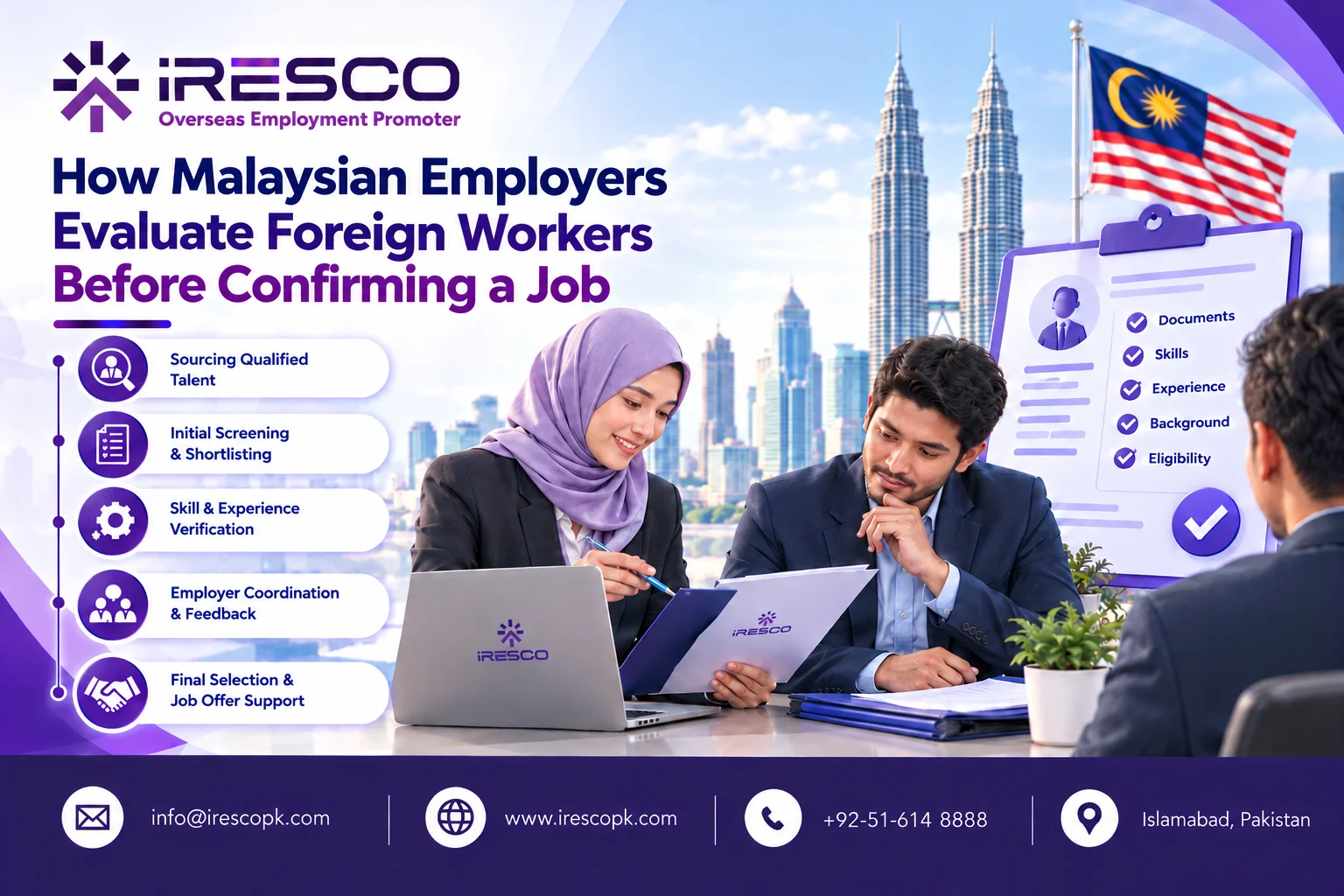
Recruitment agencies can help employers organize candidate sourcing, initial screening, document collection, interview coordination, and communication with applicants. Their responsibilities vary according to the services agreed with the employer and the applicable recruitment laws.
Employers comparing the best recruitment agency in Pakistan for Malaysia should look beyond promotional claims. They should assess the agency’s relevant recruitment experience, authorization status, screening procedures, employer relationships, communication practices, and clarity about fees.
A provider’s reputation alone does not establish that every vacancy it advertises is genuine. Employers and candidates should independently confirm the job details, contractual terms, and relevant authorization.
Checking Recruitment Credentials
Before proceeding with a recruitment provider, employers and candidates should:
- Verify its current license or registration through the relevant official authority.
- Confirm the identity of the actual Malaysian employer.
- Request a clear job description and written employment terms.
- Ask how candidate documents and personal information are handled.
- Clarify recruitment charges and who is responsible for each expense.
- Keep copies of receipts, contracts, and official communications.
People searching for the best recruitment agency in Pakistan or comparing famous recruitment agencies in Pakistan should use these checks rather than relying only on online rankings, advertisements, or testimonials.
For Pakistani applicants, checking whether a provider is a government approved overseas employment promoter is an important step. Its current status should be confirmed through Pakistan’s Bureau of Emigration and Overseas Employment or the relevant official government source. Approval should not be assumed from a website’s wording or marketing material alone.
Bulk Manpower Recruitment for Malaysian Employers
Some Malaysian businesses need to recruit several workers for the same project, production line, facility, or operational expansion. In these situations, bulk manpower recruitment requires a structured process that can handle multiple applications without sacrificing individual assessment.
Employers may need workers with similar skills, but each candidate still requires appropriate screening and document checks. Processing applications in large numbers should not mean overlooking identity discrepancies, qualification requirements, employment conditions, or applicable work authorization procedures.
How Bulk Recruitment Can Be Organized
A coordinated recruitment plan may include:
- Workforce planning: Defining the number of workers required, job categories, skills, and expected joining dates.
- Candidate sourcing: Reaching applicants who meet the basic criteria for the vacancies.
- Standardized screening: Applying consistent job-related evaluation criteria to all candidates.
- Document tracking: Recording which documents have been received, reviewed, or require correction.
- Interview scheduling: Coordinating employer interviews and practical assessments.
- Progress reporting: Updating the employer about shortlisted candidates and outstanding requirements.
Businesses considering bulk manpower recruitment services should clarify how candidates will be screened, how missing documents will be handled, and how recruitment progress will be reported. They should also confirm that the proposed recruitment arrangement complies with Malaysian requirements and Pakistan’s applicable overseas employment rules.
The objective is not simply to fill vacancies quickly. It is to identify suitable workers while maintaining accuracy, transparency, and proper documentation throughout the hiring process.
Best Practices for Ethical International Recruitment
Ethical recruitment protects both employers and workers by making the hiring process more transparent and reducing the risk of misleading job offers, unfair treatment, or unexpected costs.
Employers and recruitment providers should follow ethical international recruitment practices, including providing accurate job information, explaining employment terms before acceptance, protecting candidate data, and avoiding discriminatory screening criteria unrelated to the job.
Candidates should receive clear information about their duties, salary, working hours, location, accommodation arrangements where applicable, and any lawful deductions. They should also have a reasonable opportunity to review their employment documents and ask questions before making a commitment.
Recruitment providers should avoid promising guaranteed visas, guaranteed jobs, or outcomes they cannot control. Employers should also ensure that selection criteria are relevant to the role and applied consistently.
Ethical recruitment is not only about meeting legal obligations. It also helps establish realistic expectations, supports informed decisions, and reduces misunderstandings after workers arrive in Malaysia.
How Pakistani Candidates Can Prepare for Malaysian Employers
Candidates can improve their readiness by preparing for each stage of recruitment before an employer makes a final decision.
Start by reading the vacancy carefully and checking whether your skills, qualifications, and experience match the requirements. Prepare an accurate CV and collect the supporting documents requested by the employer or authorized recruitment provider.
Before an interview, review the responsibilities of the role and prepare genuine examples of relevant work. If a practical test is expected, revise the procedures, tools, and safety requirements associated with the occupation.
Applicants should also ask questions about the employment offer. Confirm the employer’s identity, job title, salary, working hours, contract duration, work location, and applicable work authorization arrangements. Do not rely on verbal promises when written confirmation is necessary.
If you need help understanding available recruitment support, you can explore our international recruitment services to learn about international hiring services and recruitment support.
Remember that no agency or preparation method can guarantee selection. Employers make decisions according to the vacancy, candidate suitability, and applicable employment requirements.
Common Mistakes That Can Delay Recruitment
Even qualified applicants may face delays when their applications contain avoidable errors. Common problems include:
-
Submitting an incomplete CV or leaving important employment dates unclear.
-
Providing certificates that are unreadable or inconsistent with the application.
-
Exaggerating experience or claiming qualifications that cannot be verified.
-
Ignoring the specific requirements of the advertised job.
-
Failing to prepare for interviews or practical assessments.
-
Paying fees without understanding what the payment covers.
-
Accepting an offer without checking the written employment terms.
-
Assuming that a recruitment agency’s claims are proof of official authorization.
Candidates can reduce these risks by checking documents carefully, answering questions honestly, keeping written records, and following international recruitment guidance to better understand the hiring process and employer requirements.
Employers can support a smoother process by providing clear job descriptions, consistent assessment criteria, timely feedback, and transparent communication about outstanding requirements.
Conclusion
Malaysian employers evaluate foreign workers through a combination of application screening, document verification, interviews, skills assessments, and checks required for the relevant position. The exact process varies by occupation, employer, and applicable regulations, but accuracy and job-related suitability remain important throughout recruitment.
Pakistani candidates can prepare by maintaining reliable records, demonstrating their actual skills, communicating clearly, and reviewing employment terms before accepting an offer. Employers, meanwhile, can improve recruitment outcomes by using consistent screening methods and exploring international recruitment services that support organized candidate sourcing and selection.
Whether hiring an individual employee or organizing bulk manpower recruitment, the focus should remain on matching genuine skills with real vacancies while protecting the rights and interests of everyone involved. Careful preparation and transparent communication can make international recruitment more organized and help both employers and candidates approach the process with realistic expectations.
Frequently Asked Questions
How do Malaysian employers evaluate foreign workers?
Malaysian employers may review CVs, verify qualifications and employment records, conduct interviews, assess practical skills, and check whether candidates meet the applicable employment and work authorization requirements.
What documents do Pakistani workers need for jobs in Malaysia?
Requirements vary by occupation and employer. Commonly requested documents include a valid passport, CV, educational or technical certificates, employment records, and any additional documents required for the relevant work permit process.
Do Malaysian employers conduct skills tests before hiring foreign workers?
Some employers conduct practical tests or trade assessments, particularly for technical, manufacturing, construction, and other operational roles. The assessment depends on the job’s responsibilities and required skills.
How can Pakistani applicants verify an overseas recruitment agency?
Applicants should check the agency’s current licence or authorization through Pakistan’s Bureau of Emigration and Overseas Employment, verify the employer and vacancy, and review employment terms and charges before making payments.
What is bulk manpower recruitment?
Bulk manpower recruitment is the process of sourcing and evaluating multiple workers for an employer’s staffing needs. It may involve coordinated candidate screening, document verification, interviews, skills assessments, and recruitment progress tracking.
Why are ethical recruitment practices important?
Ethical recruitment promotes transparent employment terms, fair treatment, responsible handling of personal information, and clear communication about recruitment costs and job requirements. It helps employers and candidates make informed decisions.
Can a recruitment agency guarantee a job in Malaysia?
No recruitment agency can guarantee that an employer will select a particular candidate or that all work authorization requirements will be approved. Candidates should be cautious of guaranteed-job promises and verify recruitment arrangements through official channels.
