

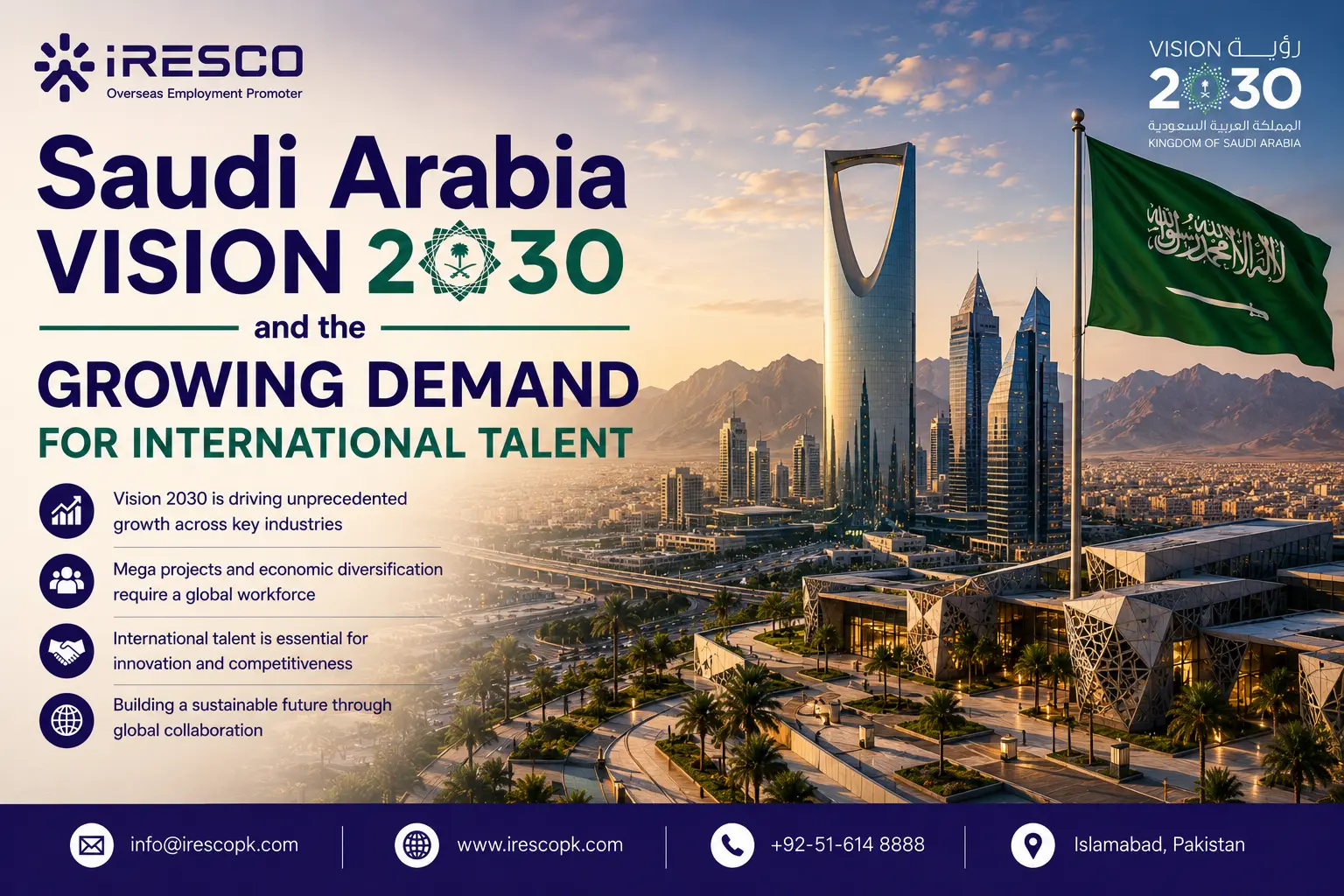
Saudi Arabia is undergoing one of the most significant economic and workforce transformations in its modern history. At the centre of this transformation is Saudi Vision 2030, an ambitious national strategy designed to diversify the economy, develop human capital, strengthen the private sector, and position the Kingdom as a global destination for investment, innovation, tourism, and business.
As Saudi Arabia moves beyond its traditional dependence on oil, new industries and mega-projects are creating demand for specialised skills across construction, engineering, technology, healthcare, tourism, hospitality, logistics, finance, manufacturing, energy, and other sectors. This transformation is also increasing the importance of international talent and skilled expatriate workers who can contribute specialised knowledge and experience.
For employers, this creates both opportunities and challenges. Finding qualified professionals, verifying their skills, managing recruitment requirements, and building an efficient international workforce require a structured approach. This is where professional recruitment agencies in Pakistan and international manpower recruitment partners can play an important role.
What Is Saudi Vision 2030?
Saudi Vision 2030 is the Kingdom’s long-term transformation strategy focused on building a diversified, prosperous, and sustainable economy. One of its major priorities is developing a competitive labour market that can support economic growth while preparing workers for future industries.
The kingdom’s labour market strategy aims to create an attractive and dynamic environment for both local and global talent. The official Vision 2030 reporting identifies goals including increasing workforce participation, improving productivity, expanding inclusive market participation, and increasing labour-market efficiency.
This transformation is changing what Saudi employers look for when hiring. Instead of relying only on traditional qualifications, companies increasingly need workers with practical expertise, digital skills, technical capabilities, international experience, and the ability to adapt to rapidly changing workplaces.
Why Is Saudi Arabia Increasingly Looking for International Talent?
The growth of international talent demand is closely connected to the scale and diversity of Saudi Arabia’s economic transformation.
Large infrastructure developments, tourism initiatives, technology investments, industrial expansion, healthcare development, and construction projects require a wide range of professional and technical capabilities.
At the same time, Saudi Arabia is investing heavily in developing its national workforce. This does not mean international recruitment is disappearing. Instead, local workforce development and international talent recruitment can work alongside each other, particularly where employers require specialised experience or skills that are difficult to source quickly.
Saudi Arabia’s Ministry of Human Resources and Social Development states that labour-market reforms are intended to improve competitiveness and attract global talent while developing national capabilities. The Ministry also highlights growing demand for skills in areas such as technology, engineering, healthcare, finance, energy, tourism, and other strategic sectors.
Key Sectors Driving International Recruitment in Saudi Arabia
Several industries are contributing to the growing demand for skilled international workers.
1. Construction and Infrastructure
Construction remains one of the most important areas of workforce demand. Large-scale infrastructure developments require engineers, project managers, electricians, welders, technicians, equipment operators, supervisors, safety professionals, and other skilled workers.
For companies working on major projects, bulk manpower recruitment can become essential because large teams may need to be mobilised within specific project timelines.
2. Technology and Digital Transformation
Saudi Arabia is rapidly developing its digital economy. Businesses need software professionals, cybersecurity specialists, data experts, AI professionals, IT engineers, digital project managers, and other technology specialists.
As artificial intelligence and automation reshape workplaces, employers increasingly need professionals who can combine technical expertise with business knowledge.
3. Healthcare
Healthcare is another important area of workforce development. Hospitals, clinics, medical facilities, laboratories, and healthcare projects require qualified doctors, nurses, technicians, administrators, pharmacists, and specialised healthcare professionals.
International recruitment can help organisations access qualified professionals when domestic talent supply does not fully meet specific requirements.
4. Tourism and Hospitality
Tourism is becoming increasingly important to Saudi Arabia’s economic diversification strategy. Hotels, resorts, restaurants, entertainment venues, travel companies, and tourism developments require professionals across hospitality, food services, management, customer service, operations, and administration.
The expansion of tourism, therefore, creates opportunities for both specialised professionals and experienced operational workers.
5. Energy, Manufacturing and Industrial Sectors
Although Saudi Arabia continues to benefit from its energy sector, Vision 2030 is also encouraging industrial diversification and new economic activities.
This creates demand for engineers, technicians, maintenance professionals, production specialists, safety personnel, skilled tradespeople, and industrial managers.
Saudi Arabia’s sectoral skills initiatives specifically cover important areas including construction, health, logistics, digital industries, financial services, tourism, hospitality, energy, manufacturing, and professional services.
The Growing Importance of Skilled Pakistani Workers
Pakistan is an important source of international manpower for Gulf countries, including Saudi Arabia. Pakistani professionals and skilled workers are present across construction, engineering, healthcare, manufacturing, hospitality, transportation, technical trades, and other industries.
For Saudi employers, recruiting from Pakistan can provide access to a large pool of professionals with relevant qualifications and international work experience.
However, successful overseas recruitment requires more than simply finding candidates. Employers need suitable screening, qualification verification, documentation, interviews, medical requirements, and other recruitment processes to ensure that candidates match the job requirements.
This makes an experienced manpower recruitment agency in Pakistan valuable for employers seeking reliable workforce solutions.
Why Skill Verification Matters in Saudi Recruitment
As the Saudi labour market becomes more specialised, employers are placing greater importance on verified qualifications and professional skills. Saudi Arabia has introduced professional verification processes for expatriate professionals to help confirm qualifications, work experience, and compatibility with occupational requirements. According to the Ministry of Human Resources and Social Development, the Professional Verification programme is designed to verify the qualifications and experience of expatriate professionals and improve workforce quality in the Saudi labour market.
For international recruitment agencies, this reinforces the importance of proper candidate screening.
A professional recruitment process should assess the following:
- Educational qualifications
- Relevant work experience
- Technical skills
- Professional certifications
- Language and communication ability
- Job-specific competencies
- References and employment history
- Documentation and eligibility
This helps employers reduce hiring risks and improve the chances of long-term workforce success.
How Vision 2030 Is Changing Employer Hiring Strategies
Saudi employers are increasingly looking beyond traditional recruitment methods. Companies need faster, more structured, and skills-focused hiring processes.
Modern international recruitment can involve several stages, including workforce planning, job analysis, candidate sourcing, screening, technical assessment, interviews, documentation, verification, and deployment.
Technology is also becoming increasingly important. Digital recruitment platforms, applicant tracking systems, AI-assisted screening, online interviews, and data-driven talent acquisition can help employers identify suitable candidates more efficiently.
However, technology alone cannot replace human judgement. Experienced recruiters are still needed to understand cultural fit, technical requirements, candidate motivation, communication skills, and employer expectations.
The combination of technology and human expertise can therefore create a more effective talent acquisition strategy.
The Role of Recruitment Agencies in Saudi Arabia’s Workforce Transformation
As companies compete for skilled professionals, recruitment agencies can help bridge the gap between employers and international talent.
A professional recruitment agency for Saudi Arabia can support employers with:
- Workforce planning
- International candidate sourcing
- Skilled worker recruitment
- Executive and professional recruitment
- Bulk manpower recruitment
- Candidate screening
- Technical assessments
- Interview coordination
- Qualification verification
- Documentation support
- Visa and deployment coordination
- Workforce mobility solutions
For employers hiring hundreds of workers, these services can significantly simplify the recruitment process. For Pakistani candidates, recruitment agencies can also provide access to legitimate overseas employment opportunities while helping employers connect with candidates who meet specific job requirements.
What Saudi Employers Should Look for in an International Recruitment Partner
Choosing the right recruitment partner is essential when hiring workers internationally. Employers should evaluate an agency based on its recruitment experience, candidate database, screening process, compliance practices, industry expertise, and ability to manage large-scale recruitment requirements. A reliable recruitment partner should also understand the employer’s business rather than simply forwarding CVs.
The recruitment process should begin with a clear understanding of the following:
- Job descriptions and responsibilities
- Required qualifications
- Technical skills
- Years of experience
- Salary and benefits
- Work location
- Number of workers required
- Joining timeline
- Documentation requirements
- Employer-specific selection criteria
This approach helps create a more accurate connection between Saudi employers and skilled workers from Pakistan.
How IRESCO Supports International Workforce Recruitment
IRESCO helps connect international employers with qualified professionals and skilled workers through structured overseas recruitment solutions.
For Saudi companies, an experienced recruitment partner can help simplify the process of sourcing candidates from Pakistan, conducting initial screening, coordinating interviews, supporting documentation, and preparing suitable candidates for deployment.
The objective is not simply to fill vacancies but to help employers build a workforce that supports productivity, operational continuity, and long-term business growth.
As Saudi Arabia continues implementing Vision 2030, organisations that can access the right skills at the right time will be better positioned to participate in the Kingdom’s expanding economy.
The Future of International Talent in Saudi Arabia
The future of Saudi Arabia’s workforce will likely combine national talent development with carefully targeted international recruitment.
The kingdom is already investing in skills development, sectoral training, workforce participation, and human-capital initiatives. HRSD reports that Saudi labour-force participation and private-sector employment have continued to grow, while national skills programmes are being aligned with high-growth sectors.
At the same time, international professionals can continue contributing specialised skills, experience, and knowledge that support emerging industries and large-scale projects.
For employers, the focus is therefore shifting from simply hiring more workers to hiring the right talent with the right skills. This makes professional recruitment, workforce planning, skills verification, and talent management increasingly important.
Conclusion
Saudi Arabia’s Vision 2030 is transforming the Kingdom’s economy and creating new demand for international talent. From construction and engineering to healthcare, technology, tourism, manufacturing, logistics, and energy, businesses need skilled professionals who can support an increasingly diversified economy.
For Saudi employers, international recruitment can provide access to specialised skills and experienced workers, particularly when supported by a reliable recruitment agency with strong sourcing and screening capabilities.
At the same time, Saudi Arabia’s investment in national skills development means the future workforce will increasingly depend on a combination of local capabilities and strategically recruited international expertise.
For companies looking to hire skilled workers from Pakistan, working with an experienced recruitment agency such as IRESCO can help make international hiring more structured, efficient, and aligned with employer requirements.
Frequently Asked Questions (FAQs)
1. How is Saudi Vision 2030 creating demand for international talent?
Saudi Vision 2030 is diversifying the economy and supporting growth in sectors such as construction, technology, healthcare, tourism, logistics, manufacturing, and energy. These expanding industries require a wide range of professional and technical skills, creating opportunities for qualified international talent.
2. Why are Saudi companies hiring skilled workers from Pakistan?
Pakistan provides access to a large workforce of professionals and skilled workers across engineering, construction, healthcare, manufacturing, hospitality, technical trades, and other sectors. Employers can use international recruitment to source candidates whose skills and experience match specific workforce requirements.
3. What industries have high demand for international workers in Saudi Arabia?
Important sectors include construction, engineering, healthcare, technology, tourism, hospitality, manufacturing, logistics, energy, and professional services. Demand varies according to project requirements, employer needs, and changing labour-market conditions.
4. How can a recruitment agency help Saudi employers?
A recruitment agency can support candidate sourcing, screening, interviews, qualification verification, documentation, workforce planning, bulk manpower recruitment, and deployment coordination. This can help employers save time and improve the quality of international hiring.
5. What should employers consider when recruiting international workers?
Employers should clearly define job requirements, qualifications, experience, technical skills, compensation, documentation, and deployment timelines. They should also work with recruitment partners that follow applicable regulations and use structured candidate screening and verification processes.
