

The global workforce is changing rapidly. Businesses across construction, healthcare, manufacturing, hospitality, oil and gas, engineering, technology, and other industries are facing increasing challenges in finding qualified professionals. As companies expand into new markets and large-scale projects create additional demand, access to skilled talent has become a strategic business priority.
This growing competition has created what can be described as a global race for skilled talent. Employers are no longer competing only with companies in their own cities or countries. They are competing for experienced professionals across international labour markets.
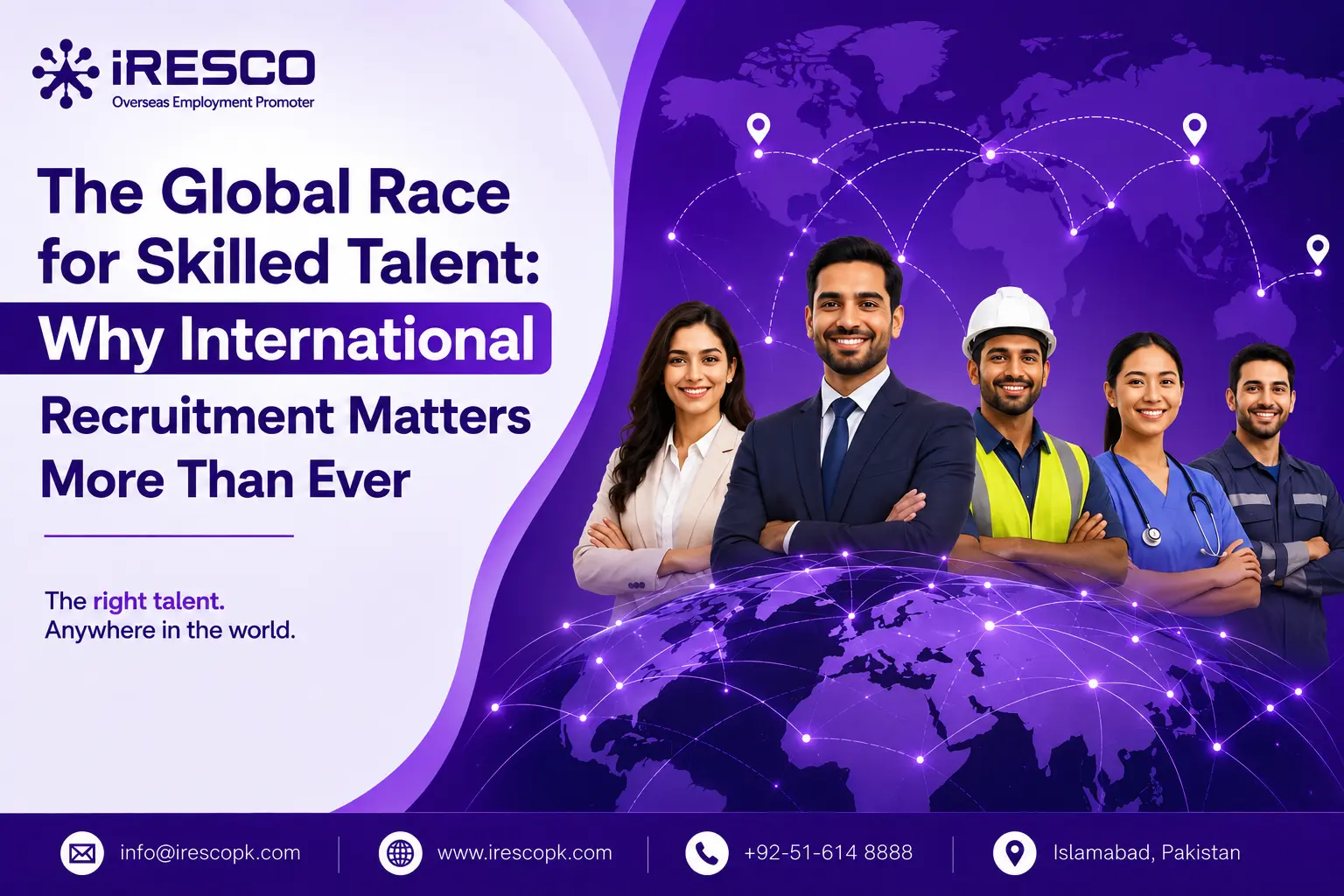
For businesses facing skill shortages, international recruitment provides an effective way to access broader talent pools, fill critical positions, support expansion, and build a workforce capable of meeting long-term business goals.
As an experienced overseas recruitment agency in Pakistan, IRESCO helps connect international employers with qualified Pakistani professionals and skilled workers through structured recruitment and workforce solutions.
What Is the Global Race for Skilled Talent?
The global race for skilled talent refers to the increasing competition among employers and countries to attract qualified workers from around the world.
Industries are evolving faster than traditional workforce systems can adapt. New technologies, infrastructure development, healthcare expansion, manufacturing growth, and major construction projects are creating demand for workers with specialised skills.
At the same time, many countries are experiencing shortages in specific occupations. This means employers often cannot depend entirely on their local labour markets.
International recruitment allows businesses to look beyond geographical boundaries and connect with professionals who have the qualifications, experience, and technical capabilities required for specific positions.
Why Skilled Talent Has Become a Global Business Priority
Having the right people in the right positions directly affects productivity, project timelines, service quality, and business growth.
When critical positions remain vacant, companies may experience the following:
- Delayed projects
- Increased overtime costs
- Reduced productivity
- Higher recruitment expenses
- Increased workload for existing employees
- Difficulty meeting customer expectations
- Delays in business expansion
For this reason, talent acquisition is increasingly becoming a strategic function rather than simply an HR activity. Companies that can build reliable access to skilled workers are better positioned to respond to market opportunities and maintain operational efficiency.
The Growing Demand for International Recruitment
International recruitment has become increasingly important because employers can access talent markets that may have a larger supply of specific skills. Countries with strong populations of trained professionals and technical workers can become important sources of international talent. Pakistan, for example, has a large workforce that includes professionals and skilled workers across multiple sectors. These include:
- Engineers
- Healthcare professionals
- Technicians
- Construction workers
- Electricians
- Welders
- Plumbers
- Drivers
- Hospitality professionals
- Manufacturing workers
- Skilled tradespeople
For international employers, accessing such talent pools can provide greater flexibility when local recruitment does not produce enough qualified candidates.
How International Recruitment Helps Employers Access Global Talent
1. Access to a Larger Talent Pool
One of the biggest advantages of international recruitment is access to candidates beyond the employer’s local market.
Instead of limiting recruitment to one city or country, businesses can search across international talent pools. This increases the possibility of finding candidates with specialised qualifications and relevant experience.
A broader talent pool is particularly valuable for industries experiencing shortages of technical or specialised workers.
2. Filling Critical Skill Gaps
Not every labour market contains enough workers for every occupation. International recruitment enables employers to identify professionals who possess specific technical skills that may be difficult to find locally. This can be especially important for industries such as construction, engineering, healthcare, manufacturing, oil and gas, and facility management.
By addressing skill gaps efficiently, companies can maintain operations and reduce the risk of prolonged vacancies.
3. Supporting Large-Scale Hiring
Large projects often require hundreds or even thousands of workers within a specific timeframe. Traditional recruitment methods may struggle to manage such requirements.
An experienced international recruitment partner can support bulk manpower recruitment by sourcing candidates, organising screening, coordinating interviews, managing documentation, and supporting deployment processes. This structured approach allows employers to manage large recruitment campaigns more efficiently.
Why Pakistan Is an Important Source of International Talent
Pakistan has a large and diverse workforce with experience across technical, professional, and skilled occupations.
Its workforce includes candidates who are already familiar with international employment environments and the requirements of industries operating in the Gulf, the Middle East, Europe, and other international markets.
For employers, recruiting from Pakistan can provide access to a broad candidate pool while allowing them to search for workers according to specific qualifications and job requirements.
However, successful international recruitment requires more than simply finding candidates. Employers also need proper screening, documentation, compliance, communication, and deployment support.
This is where a professional manpower recruitment agency in Pakistan can provide significant value.
The Role of Recruitment Agencies in the Global Talent Race
International recruitment agencies act as a bridge between employers and overseas candidates.
Their role can involve several stages of the recruitment process, including:
- Understanding employer requirements
- Preparing job specifications
- Candidate sourcing
- CV screening
- Skills assessment
- Candidate shortlisting
- Interviews and selection
- Documentation
- Employment processing
- Visa and deployment coordination
A reliable recruitment partner helps employers manage these stages systematically rather than handling every part of international hiring independently.
Why Candidate Quality Matters More Than Candidate Quantity
International recruitment should not be based simply on finding the largest possible number of candidates. The objective should be finding the right candidates for the right positions.
Sending hundreds of unsuitable CVs may create more work for HR departments without solving the employer’s actual hiring problem.
Effective recruitment focuses on factors such as:
- Qualifications
- Relevant experience
- Technical skills
- Job-specific competencies
- Communication ability
- Professional background
- Availability
- Employer requirements
Quality-focused candidate matching can improve hiring efficiency and reduce the risk of unsuitable placements.
International Recruitment and Workforce Mobility
The modern workforce is increasingly mobile. Professionals and skilled workers are willing to move across borders when they find suitable career opportunities, competitive employment packages, and reputable employers.
For companies, this creates an opportunity to build international teams based on skills rather than geographical limitations. Global workforce mobility can help businesses respond to changing labour requirements while giving qualified professionals access to international career opportunities.
However, successful workforce mobility requires proper planning. Employers need to understand recruitment procedures, employment documentation, immigration requirements, cultural considerations, and worker expectations.
The Importance of Compliance in International Hiring
International recruitment involves more than candidate selection. Employers and recruitment partners must pay attention to employment documentation, applicable regulations, work permits, visas, contracts, and other requirements.
A structured and transparent recruitment process helps reduce administrative problems and protects both employers and candidates. This is particularly important when companies are hiring workers in large numbers or recruiting for multiple locations.
Working with an experienced recruitment partner can help employers navigate the administrative side of overseas workforce deployment more effectively.
How Technology Is Changing International Recruitment
Technology is also transforming the global recruitment process. Modern recruitment teams can use digital platforms and data-driven tools to improve candidate sourcing, communication, screening, and workforce management.
Technology can help recruiters:
- Organize large candidate databases
- Identify candidates based on specific criteria
- Speed up CV screening
- Coordinate virtual interviews
- Maintain recruitment records
- Improve communication
- Track candidate progress
However, technology does not eliminate the importance of human expertise.
International recruitment involves factors such as communication, experience verification, cultural understanding, employer expectations, and candidate suitability. Human judgement remains essential when making final hiring decisions. The strongest recruitment strategies combine technology with professional recruitment expertise.
How International Recruitment Supports Business Growth
Recruitment is ultimately connected to business performance.
A company cannot successfully expand without the workforce required to support that expansion.
International recruitment can help organisations:
- Enter new markets
- Expand project capacity
- Maintain operational continuity
- Fill specialized positions
- Respond to workforce shortages
- Support large-scale projects
- Build diverse teams
For companies experiencing rapid growth, access to international talent can become a competitive advantage.
Choosing the Right International Recruitment Partner
Choosing a recruitment partner is an important decision for employers. Before working with an international recruitment agency, companies should consider:
Industry Experience
The recruitment partner should understand the employer’s industry and the skills required for specific roles.
Candidate Screening
Employers should look for a recruitment process that emphasises candidate quality rather than simply candidate volume.
Transparent Processes
Clear communication regarding recruitment stages, documentation, timelines, and responsibilities helps create a stronger employer-recruiter relationship.
International Workforce Experience
Experience with overseas hiring and workforce deployment can help employers navigate the complexities of cross-border recruitment.
Employer Support
A strong recruitment partner should provide support throughout the hiring process rather than disappearing after candidate selection.
Why International Recruitment Matters More Than Ever
The global competition for skilled talent is unlikely to disappear. As economies expand, industries adopt new technologies, and large infrastructure projects continue to develop, demand for specialised workers will remain strong. Employers that rely exclusively on local recruitment may find themselves competing for a limited number of candidates.
International recruitment provides another option: accessing talent wherever the right skills are available.
For businesses, the objective is not simply to hire internationally. It is to build a reliable, compliant, efficient, and sustainable workforce strategy.
How IRESCO Supports Global Employers
IRESCO provides international recruitment and overseas employment solutions for employers seeking qualified workers from Pakistan. As an Overseas Employment Promoter, IRESCO focuses on connecting employers with suitable Pakistani talent while supporting the recruitment and deployment process.
From candidate sourcing and screening to documentation and workforce coordination, a structured recruitment approach can help employers simplify international hiring.
For organisations looking to expand their talent search beyond traditional labour markets, partnering with an experienced recruitment agency can make the process more organised and efficient.
Conclusion
The global race for skilled talent is changing how companies approach workforce planning. Skills shortages, international business expansion, major infrastructure projects, and evolving industries are pushing employers to look beyond traditional recruitment markets.
International recruitment provides businesses with access to broader talent pools, specialised skills, and workforce flexibility. When supported by effective candidate screening, compliance procedures, technology, and professional recruitment expertise, international hiring can become an important part of long-term business strategy.
For employers seeking qualified talent from Pakistan, IRESCO offers a structured approach to international recruitment and workforce solutions. In a competitive global labour market, finding the right talent is no longer limited by geography—it is about connecting businesses with the skills they need wherever those skills are available.
Frequently Asked Questions (FAQs)
1. What is international recruitment?
International recruitment is the process of sourcing, screening, selecting, and hiring qualified workers from another country. It enables employers to access broader talent pools when suitable candidates are not readily available in their local market.
2. Why is international recruitment important for employers?
International recruitment helps employers address skill shortages, access specialised talent, support large-scale projects, and expand their workforce beyond local labour markets.
3. Why do companies recruit skilled workers from Pakistan?
Pakistan has a large and diverse workforce that includes professionals, technical specialists, and skilled workers across construction, healthcare, engineering, manufacturing, hospitality, and other industries.
4. What does an international recruitment agency do?
An international recruitment agency can support employers with candidate sourcing, screening, interviews, selection, documentation, recruitment coordination, and overseas workforce deployment.
5. How can IRESCO help international employers?
IRESCO helps international employers connect with qualified Pakistani talent and provides overseas recruitment and workforce solutions designed to make the international hiring process more structured and efficient.
