

The Gulf region has become one of the world’s busiest markets for international talent. Saudi Arabia, the United Arab Emirates, Qatar, Oman, Kuwait, and Bahrain are investing heavily in infrastructure, healthcare, technology, tourism, energy, logistics, and industrial development. Behind all this growth is a simple requirement that is often overlooked: people. Every new project needs engineers, technicians, healthcare professionals, IT specialists, skilled tradespeople, supervisors, and support staff who can turn plans into reality.
This is one of the reasons Pakistani workers in Gulf countries continue to have a strong presence. Pakistani professionals and skilled workers have been part of the Gulf’s development for decades, and their experience now extends far beyond traditional construction jobs. From engineers working on major infrastructure projects to doctors serving in hospitals and IT professionals supporting digital businesses, Pakistani talent can be found across many parts of the GCC economy.
The continued preference for Pakistani talent is not based on one single factor. It comes from a combination of technical skills, practical experience, adaptability, English communication, competitive workforce costs, and a long-standing relationship between Pakistan and the Gulf countries. As the region enters another period of rapid economic development, these qualities are becoming increasingly valuable.
A Long-Standing Workforce Relationship Between Pakistan and the Gulf
The connection between Pakistan and the Gulf goes back many decades. Long before today’s mega-projects and ambitious economic visions, Pakistani engineers, doctors, teachers, accountants, technicians, drivers, and construction workers were already contributing to the growth of Gulf economies.
Decades of Experience Have Built Trust
For Pakistani workers, the Gulf is also a familiar destination. Millions of Pakistanis have built their careers in countries such as Saudi Arabia, the UAE, Qatar, Oman, Kuwait, and Bahrain. Many new workers arrive with some understanding of Gulf workplace culture because relatives, friends, or former colleagues have already worked in the region.
This familiarity can help workers adapt to:
- Gulf workplace culture and expectations
- Multicultural working environments
- Professional communication standards
- Local workplace practices
- Working with international teams
The relationship has also created established recruitment networks between Pakistan and the GCC. Experienced Pakistani recruitment agencies understand the requirements of Gulf employers, while employers and candidates are already familiar with the process of seeking overseas employment.
Gulf Economic Growth Is Increasing Demand for Skilled Workers
The scale of development taking place across the Gulf is changing the region’s workforce requirements. Saudi Arabia’s Vision 2030, the UAE’s economic diversification plans, Qatar’s infrastructure development, and investment programmes in Oman, Kuwait, and Bahrain are creating opportunities across a wide range of industries.
Saudi Vision 2030 and the Need for Human Capital
Saudi Arabia is perhaps the clearest example of this transformation. The country’s Vision 2030 development plans cover tourism, entertainment, infrastructure, technology, healthcare, manufacturing, logistics, and other sectors. Projects on this scale require huge numbers of workers with different qualifications and experience levels.
The demand is therefore not limited to general labor. A major development project may require civil engineers, electrical engineers, mechanical technicians, quantity surveyors, safety officers, welders, electricians, equipment operators, project managers, accountants, and administrative staff.
This broad requirement creates opportunities for Pakistani manpower because Pakistan has a large and diverse workforce. The country can provide candidates for both skilled trades and professional occupations, allowing employers to recruit according to the specific needs of their projects.
Pakistani Skilled Workers Bring Valuable Practical Experience
One of the biggest advantages of hiring experienced workers is that they understand what it means to perform a job in a real working environment. A qualification can demonstrate education, but practical experience shows whether a person can actually use that knowledge under pressure.
This is particularly important in construction, engineering, manufacturing, maintenance, and industrial operations.
Skilled Trades Remain in High Demand
Pakistan has a large pool of electricians, plumbers, HVAC technicians, welders, mechanics, carpenters, masons, machine operators, steel workers, and other tradespeople. Many have spent years developing their skills before applying for international employment.
For Gulf employers working on major projects, this hands-on experience can be extremely useful. A technician who already understands equipment, tools, safety procedures, and common workplace problems may require less basic training than someone entering the industry for the first time.
However, employers should never rely solely on a candidate’s CV. Technical assessments and trade testing are important parts of responsible recruitment because they allow companies to verify whether a candidate actually possesses the skills being claimed.
This is also where professional overseas recruitment agencies can add value by supporting global talent hiring and screening candidates before presenting them to employers.
Construction Continues to Offer Major Opportunities
Construction remains one of the largest employment sectors for Pakistani workers in the Gulf. The region continues to develop residential communities, commercial buildings, roads, airports, industrial facilities, tourism destinations, and large infrastructure networks.
From Engineers to Skilled Tradespeople
Pakistani engineers are involved in areas such as civil engineering, electrical engineering, mechanical engineering, project supervision, surveying, and quantity surveying. At the same time, skilled tradespeople are working on electrical installations, plumbing, welding, steel fabrication, masonry, carpentry, mechanical systems, and equipment operation.
A large construction project needs all of these roles working together. An engineer may design or supervise the project, while technicians and tradespeople turn those plans into physical structures.
Depending on the project’s requirements, employers may need professionals and skilled workers for roles such as:
- Civil and electrical engineering
- Mechanical and technical supervision
- Welding and steel fabrication
- Plumbing and electrical installation
- Masonry, carpentry, and equipment operation
This is why the strength of the Pakistani workforce is not simply its size. Its diversity is equally important. Employers can find candidates across different levels of experience and specialization.
The Gulf’s Digital Economy Is Opening New Doors for Pakistani IT Professionals
The image of Pakistani overseas workers is gradually changing. Construction and skilled trades remain important, but the country’s technology professionals are becoming increasingly relevant to Gulf employers.
Saudi Arabia and the UAE are investing heavily in artificial intelligence, cybersecurity, cloud computing, fintech, smart cities, digital government services, and other technology-driven industries.
Growing Demand for Technology Skills
Pakistan has developed a large technology workforce that includes software developers, cybersecurity specialists, cloud engineers, network administrators, data analysts, system administrators, and IT support professionals.
Many Pakistani IT professionals also have experience working with international clients. Pakistan’s growing freelance and software services industries have exposed many technology workers to international project management, remote collaboration, and global clients.
These skills are particularly relevant for roles such as:
- Software development and programming
- Cybersecurity and network administration
- Cloud computing and system administration
- Data analysis and IT support
- Remote project management and collaboration
This experience can be valuable when they move into Gulf-based companies where teams are often made up of employees from several countries.
The opportunity is particularly interesting because it shows how the Pakistan-Gulf employment relationship is expanding beyond traditional manpower recruitment and moving toward specialized professional talent.
Healthcare Is Another Important Area for Pakistani Professionals
Healthcare has always been an important employment sector for Pakistani professionals and recruitment services in the Gulf. Hospitals, clinics, laboratories, and specialist medical centres require qualified staff, and the region continues to invest in healthcare infrastructure and specialized services.
Doctors, Nurses, and Medical Specialists
Pakistani doctors, nurses, pharmacists, laboratory technicians, physiotherapists, and other healthcare professionals have built careers across GCC countries.
Many Pakistani medical professionals have experience working in demanding hospital environments where teamwork, communication, and the ability to remain calm under pressure are essential. English is also widely used in medical education and professional communication, which can help qualified Pakistani candidates work effectively in international healthcare environments.
At the same time, healthcare recruitment requires careful verification. Professional licensing, qualifications, experience, and regulatory requirements vary by country, so employers need to make sure candidates meet all relevant standards through proper candidate screening before deployment.
Oil, Gas, and Industrial Sectors Still Need Technical Talent
The Gulf may be diversifying its economies, but oil and gas remain important industries in several GCC countries. These sectors require experienced technical workers who understand industrial equipment, maintenance procedures, safety standards, and plant operations.
Technical Expertise for Industrial Operations
Pakistani petroleum engineers, mechanical technicians, electrical technicians, plant operators, welders, maintenance specialists, and safety professionals can contribute to industrial facilities, refineries, power plants, and manufacturing operations.
Industrial employers cannot afford frequent mistakes. Equipment downtime can be extremely expensive, while poor safety practices can put entire teams at risk. Experienced technical workers who understand their responsibilities can therefore provide considerable value to reliable talent.
This is another reason practical experience matters so much when Gulf companies recruit from Pakistan.
Adaptability Helps Pakistani Workers Fit Into Multicultural Teams
Walk into a large Gulf workplace and you will quickly notice how international it is. A construction project, hospital, hotel, factory, or corporate office can have employees from many different countries working together.
That environment requires adaptability.
Working Across Different Cultures
Pakistani workers often have considerable experience working alongside people from different backgrounds. Those who have already spent time in the Gulf are usually familiar with local customs and workplace expectations, while many others have gained international exposure through previous employment.
English is also commonly used in professional and technical workplaces throughout the GCC. Many Pakistani professionals have studied or worked in English, which can make communication easier when working with international colleagues.
Some workers also learn conversational Arabic after moving to the Gulf. Even basic Arabic can be useful for everyday communication, particularly in GCC workplaces where employees and supervisors come from different linguistic backgrounds.
The ability to adjust to a new environment does not eliminate every challenge, but it can make the transition considerably smoother.
Competitive Workforce Costs Add to the Appeal
Every company has to consider its budget when hiring. This becomes especially important for large projects that may require hundreds or thousands of employees.
For employers, however, the cheapest worker is not necessarily the most economical worker.
Employers Look at Overall Value
The real cost of hiring someone includes recruitment, training, productivity, retention, and the time required before the employee becomes fully effective.
This is where Pakistani talent can offer a competitive balance. Employers can access professionals and skilled workers with different levels of experience while maintaining reasonable workforce costs and building a talent pipeline.
The focus should always be on value rather than simply paying the lowest possible salary. A properly trained and experienced worker who performs consistently can provide far greater value than a cheaper employee who lacks the necessary skills.
This is particularly relevant for construction companies, industrial businesses, hospitality groups, logistics companies, and other employers managing large workforces.
Recruitment Agencies Are Making Gulf Hiring More Structured
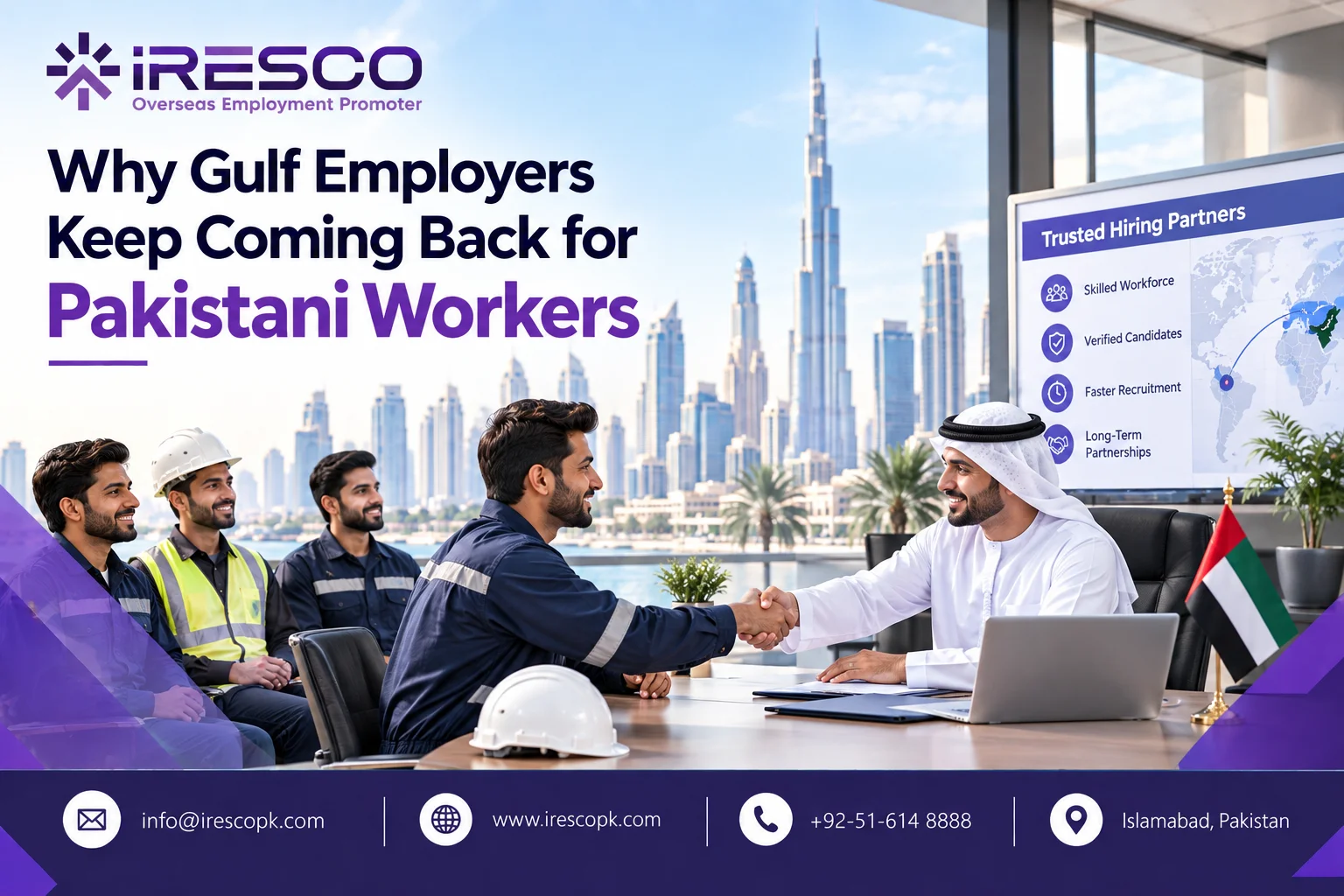
International recruitment involves considerably more than finding candidates. Employers have to deal with interviews, qualifications, technical skills, documentation, medical requirements, employment contracts, visas, and deployment arrangements.
This is why Pakistani recruitment agencies have become an important part of the Pakistan-Gulf employment pipeline.
From Candidate Sourcing to Final Deployment
A professional recruitment process may involve sourcing candidates, screening CVs, verifying qualifications, conducting interviews, arranging technical tests, completing medical procedures, handling documentation, and assisting with visa processing.
The objective is simple: employers should receive candidates who actually match their requirements.
This becomes particularly important when a company is recruiting at scale. If an employer needs 200 electricians or 100 technicians, manually finding and evaluating every candidate can consume enormous amounts of time.
Experienced recruitment partners can streamline this process by maintaining candidate databases and using structured skilled worker screening procedures.
Technology Is Improving Overseas Recruitment
Recruitment practices are changing alongside the wider economy. Digital databases, online interviews, electronic document management, and automated candidate filtering are making it easier for recruitment companies to handle international hiring campaigns.
Better Matching Between Employers and Candidates
Modern recruitment technology allows agencies to organize candidates according to qualifications, experience, technical skills, certifications, language ability, and other requirements.
This can make candidate matching faster and more accurate. Agencies can use technology to:
- Organize candidate profiles
- Filter workers by skills and experience
- Match qualifications with job requirements
- Track certifications and documentation
- Speed up the candidate selection process
Still, technology is not a replacement for human judgment. A database can identify a candidate who appears to have ten years of experience, but an experienced recruiter still needs to determine whether that experience is relevant to the employer’s actual requirements.
For this reason, the strongest recruitment systems combine technology with interviews, technical assessments, document verification, and human evaluation.
The Demand Is Moving Beyond Traditional Labor
Perhaps the most important change in Gulf recruitment is the growing demand for specialized skills.
For many years, discussions about overseas employment from Pakistan focused heavily on construction, driving, general labor, and other traditional occupations. These categories remain important, but the Gulf economy is becoming much more sophisticated.
New Industries Need New Skills
Artificial intelligence, renewable energy, cybersecurity, advanced manufacturing, apparel and textile industries, healthcare technology, aviation, logistics, tourism, and digital services are creating jobs that require specialized knowledge.
This gives Pakistan an opportunity to strengthen its position as a source of international talent.
Instead of competing only through the size of its workforce, Pakistan can increasingly compete through technical expertise and professional qualifications.
For that to happen, workers need access to quality vocational training, internationally recognized certifications, modern technical education, and stronger communication skills.
What Gulf Employers Should Consider When Hiring Pakistani Workers
Hiring from Pakistan can be an effective workforce strategy, but successful recruitment still depends on proper planning.
Employers should begin by clearly defining the vacancy. Job descriptions should specify qualifications, experience, certifications, technical abilities, language requirements, and responsibilities.
Candidates should then be evaluated against those criteria.
Proper Screening Protects Both Sides
Technical positions should ideally include practical assessments or trade tests. Candidate screening should also involve verifying documents and employment histories before deployment.
Clear employment terms are equally important. Workers should understand their salary, job responsibilities, working conditions, accommodation arrangements, and other important details before travelling.
A transparent recruitment process protects employers from unsuitable hires while also protecting workers from misunderstandings about the jobs they are accepting.
This approach creates a stronger foundation for long-term employment and helps maintain the trust that has developed between Pakistan and Gulf countries over many years.
The Future of Pakistani Talent in the Gulf
The Gulf’s workforce requirements are likely to become even more diverse in the coming years.
Construction and infrastructure will continue to create employment, but future opportunities are expected to expand further into technology, healthcare, renewable energy, logistics, tourism, advanced manufacturing, and professional services.
Skills Will Matter More Than Ever
For Pakistani workers, this means the future opportunity is not simply about going abroad. It is about going abroad with better skills.
A worker with a recognized certification, solid experience, good communication skills, and knowledge of modern equipment or technology will naturally have more opportunities than someone without specialized training.
The same principle applies to professionals. Engineers, IT specialists, healthcare workers, accountants, managers, and other professionals who continue developing their expertise will be better positioned to compete in the Gulf’s evolving labor market.
For employers, this means Pakistan can continue to be an important source of both skilled workers and professional talent.
Why the Pakistan-Gulf Workforce Partnership Is Here to Stay
The relationship between Pakistani workers and Gulf employers has already lasted for generations. There is little reason to expect it to disappear as the Gulf economy changes.
If anything, the relationship is likely to become more specialized.
Gulf countries need people to support their ambitious development plans, while Pakistan has a large pool of workers and professionals seeking international opportunities. Both sides benefit when recruitment is transparent, skills are properly assessed, and workers are matched with jobs that genuinely suit their qualifications.
The next stage of this relationship will therefore depend on quality as much as quantity.
Pakistan has the opportunity to become an even stronger source of engineers, IT professionals, healthcare workers, technicians, skilled tradespeople, and other specialists through international recruitment for the GCC.
Conclusion
The continued demand for Pakistani workers in Gulf countries is the result of a relationship built over decades rather than a temporary recruitment trend.
Pakistani professionals and skilled workers have already contributed to construction, engineering, healthcare, IT, energy, logistics, manufacturing, hospitality, and many other industries across the GCC. Their practical experience, technical abilities, adaptability, and familiarity with Gulf workplaces have made them a valuable part of the region’s international workforce.
At the same time, the Gulf economy is changing. Saudi Arabia, the UAE, Qatar, Oman, Kuwait, and Bahrain are investing in industries that require increasingly specialized skills. This creates an opportunity for Pakistan to move beyond traditional manpower supply and provide a wider range of highly trained professionals and technical workers.
For Gulf employers seeking reliable talent, the appeal of Pakistani talent lies in the overall value it can provide. For Pakistani workers, the growing Gulf economy offers opportunities to build international careers and develop their skills.
If both sides continue to focus on proper recruitment, genuine qualifications, technical training, fair employment practices, and professional standards, the Pakistan-Gulf workforce partnership can remain strong for many years to come.
Frequently Asked Questions (FAQs)
1. Why are Pakistani workers in high demand in Gulf countries?
Pakistani workers are in demand because of their technical skills, practical experience, adaptability, professional qualifications, and familiarity with Gulf workplaces. Pakistan also has a large workforce covering a wide range of skilled trades and professional occupations.
2. Which industries hire Pakistani workers in the Gulf?
Pakistani workers are employed across construction, engineering, healthcare, IT, oil and gas, manufacturing, logistics, hospitality, facility management, transportation, and maintenance. New opportunities are also developing in technology, renewable energy, tourism, and other emerging sectors.
3. Why do Gulf employers hire Pakistani skilled workers?
Pakistani skilled workers often bring hands-on experience in areas such as electrical work, welding, plumbing, HVAC, mechanical maintenance, construction, and equipment operation. Their practical experience can be valuable for projects where productivity and technical competence are important.
4. How do recruitment agencies help Gulf employers hire from Pakistan?
Pakistani recruitment agencies can assist with candidate sourcing, CV screening, interviews, technical assessments, qualification verification, medical processing, documentation, visa procedures, and deployment. A structured recruitment process helps employers find candidates who match their actual requirements.
5. Will demand for Pakistani professionals in the Gulf continue to grow?
Demand is likely to remain significant as GCC countries continue investing in infrastructure, healthcare, technology, tourism, logistics, energy, and industrial development. Professionals and workers with specialized skills, relevant experience, and internationally recognized qualifications are likely to have the strongest opportunities.
