

The global workforce is undergoing a major transformation. Businesses are no longer limited to hiring talent within their local markets. As industries expand, technology changes job requirements, and demand for specialized skills increases, employers are looking beyond national borders to find the right people. This shift has created what can be called the talent mobility revolution, a new era in which skilled workers move across countries to access better opportunities while businesses build international teams to meet their workforce needs.
For employers, this transformation creates both opportunities and challenges. Finding qualified candidates is no longer simply about posting a vacancy and waiting for applications. Companies increasingly need strategic international recruitment, reliable manpower recruitment, effective workforce planning, and access to global talent networks.
For skilled workers, international employment can provide opportunities to develop careers, gain global experience, and contribute to industries experiencing talent shortages.
At IRESCO, we understand the importance of connecting employers with qualified professionals and skilled workers through structured overseas employment and international recruitment solutions. As global employment continues to evolve, organizations that understand talent mobility will be better positioned to build flexible, capable, and future-ready workforces.
What Is Talent Mobility?
Talent mobility refers to the movement of skilled workers between locations, organizations, industries, and countries to meet changing employment and business requirements. In the context of global employment, it particularly describes how professionals and skilled workers move internationally to access employment opportunities while helping businesses address workforce shortages.
Talent mobility is not simply about workers relocating from one country to another. It includes the broader process of identifying skills, matching candidates with suitable employers, managing international recruitment, supporting employment requirements, and creating sustainable workforce connections.
Today, international talent mobility is becoming increasingly important because businesses in many markets require skills that may not be readily available within their domestic workforce.
Why Global Talent Mobility Is Growing
Several factors are contributing to the rapid growth of global talent mobility. Businesses are expanding into new markets, infrastructure projects are increasing workforce requirements, and technological developments are creating demand for specialized skills.
At the same time, demographic changes and shortages in certain professions are making it difficult for employers to fill positions locally. This has encouraged businesses to consider global talent acquisition as part of their long-term workforce strategy.
Growing Demand for Skilled Workers
One of the biggest drivers of international recruitment is the growing demand for skilled workers. Industries such as construction, healthcare, manufacturing, oil and gas, engineering, hospitality, logistics, and information technology require employees with specific technical knowledge and practical experience.
When local talent pools cannot provide enough qualified candidates, employers can expand their search internationally.
Global Workforce Shortages
Workforce shortages are no longer limited to individual companies. Entire industries and economies can experience shortages of qualified workers.
International recruitment provides employers with access to larger talent pools and allows them to connect with workers who possess the skills required for specific positions. This makes overseas recruitment an increasingly important part of modern workforce planning.
Economic Expansion
Economic development creates new employment opportunities and increases demand for talent. Countries investing heavily in infrastructure, tourism, healthcare, energy, technology, and industrial development often require large numbers of skilled and semi-skilled workers.
For example, the continued transformation of the Gulf region is creating opportunities for professionals, technical workers, project specialists, and other skilled employees from international markets.
How Skilled Workers Are Changing Global Employment
The movement of skilled workers is changing how businesses think about recruitment. Instead of viewing employees only as local resources, employers are increasingly treating talent as a global strategic resource. This creates a more interconnected employment environment.
Skills Are Becoming More Important Than Location
Traditionally, businesses often recruited employees based on geographical proximity. Today, the availability of specific skills can be more important than where a candidate lives.
A company may find the ideal engineer, healthcare professional, technician, construction specialist, or skilled worker in another country. This shift is helping create a global skills economy, where professional capabilities can connect workers with employers across international borders.
International Experience Is Becoming Valuable
Employees who have worked in different countries can bring valuable perspectives to organizations. International experience can expose workers to different workplace cultures, technologies, management systems, safety standards, and business practices.
For employers, internationally experienced professionals can therefore provide more than technical skills—they can contribute broader knowledge and adaptability.
Workers Are Becoming More Globally Connected
Digital communication and professional networking have made it easier for workers to discover opportunities in international markets. Professionals can research employers, understand overseas employment requirements, communicate with recruitment agencies, and prepare for international career opportunities without initially being physically present in the destination country. This connectivity is helping accelerate global talent mobility.
The Role of International Recruitment Agencies
As international hiring becomes more complex, recruitment agencies play an important role in connecting employers with qualified candidates.
A professional international recruitment agency can help businesses identify suitable talent, manage candidate screening, coordinate recruitment processes, and support the documentation required for overseas employment. For employers, this can reduce the complexity of searching across international markets.
Connecting Employers With Skilled Workers
A recruitment agency can develop talent networks across different countries and industries. Instead of relying entirely on local applications, employers can gain access to broader pools of skilled workers.
This is particularly valuable for businesses that need multiple employees for large projects or require candidates with specialized experience.
Supporting Manpower Recruitment
Manpower recruitment involves identifying and supplying workers according to an employer’s workforce requirements.
For large-scale construction projects, industrial operations, healthcare organizations, hospitality businesses, and other labor-intensive sectors, manpower recruitment can help companies fill multiple positions efficiently. A structured recruitment process can also improve candidate quality by matching skills, experience, qualifications, and job requirements.
Improving Recruitment Efficiency
International hiring can involve multiple stages, including candidate sourcing, interviews, documentation, employment contracts, visa-related procedures, and travel preparation.
Experienced recruitment professionals can help coordinate these stages and reduce unnecessary delays. This allows employers to focus more on their business operations while recruitment specialists manage the talent acquisition process.
Why Pakistan Is Becoming Important to Global Talent Mobility
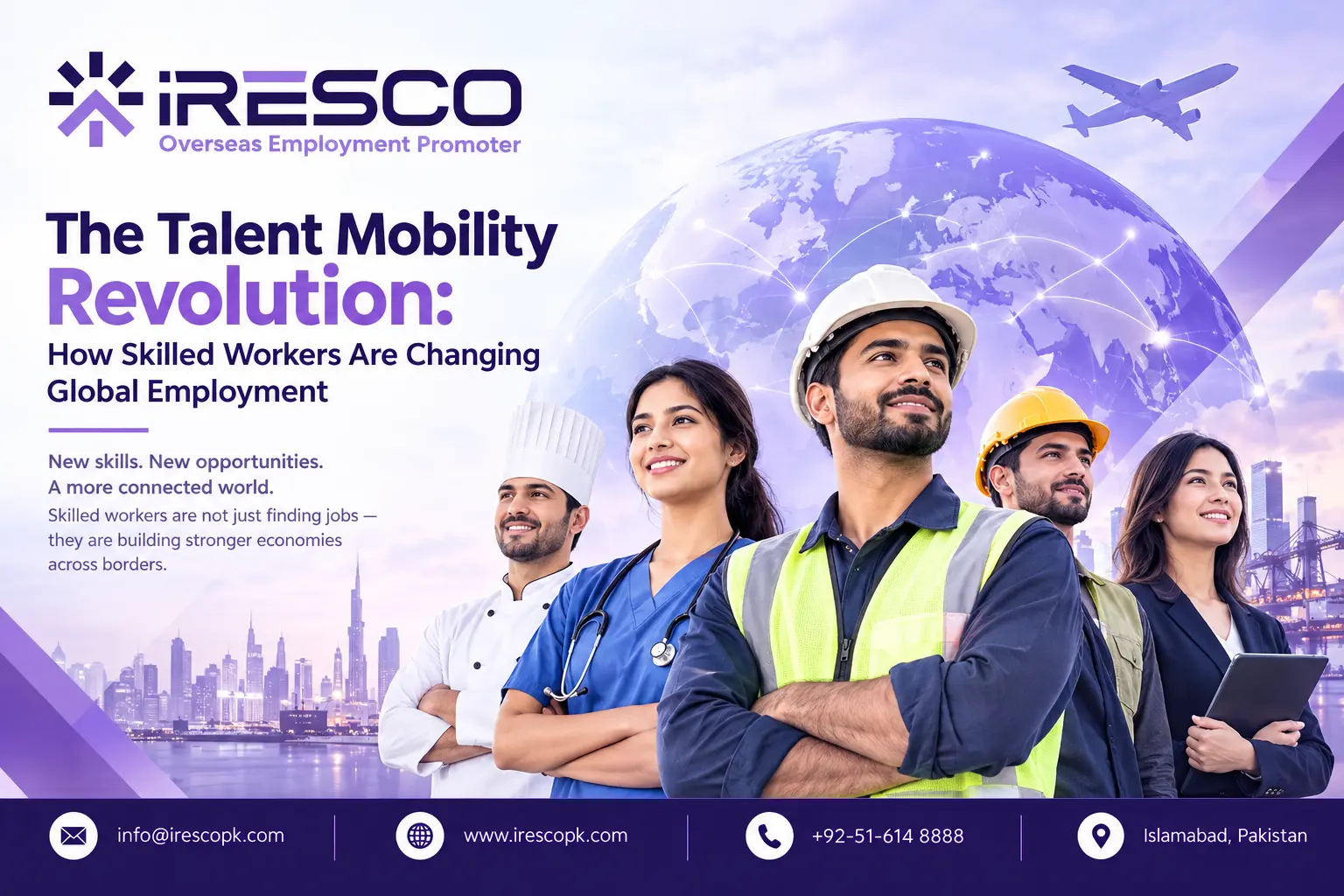
Pakistan has a large and diverse workforce that includes professionals, skilled workers, semi-skilled workers, technicians, and experienced employees across multiple sectors.
This makes Pakistan an important source market for international employers looking for qualified talent. Pakistani professionals and skilled workers are already contributing to industries across the Middle East and other international markets.
A Diverse Skilled Workforce
Pakistan produces talent across engineering, healthcare, construction, information technology, manufacturing, hospitality, technical trades, and other professional fields. This diversity allows international employers to explore candidates according to their specific workforce requirements.
Strong Overseas Employment Potential
The country’s established overseas employment ecosystem has helped connect Pakistani workers with international opportunities.
For employers, working with a reliable overseas employment promoter or international recruitment agency can make it easier to identify suitable candidates and manage recruitment requirements.
Access to Emerging Global Opportunities
As international markets continue to require additional workers, Pakistani talent can play an important role in addressing workforce gaps. Professional recruitment organizations can help connect qualified Pakistani candidates with employers that need their skills and experience.
Saudi Arabia and the New Era of Talent Mobility
Saudi Arabia is one of the most important markets for international recruitment in the region. Economic diversification, infrastructure development, industrial expansion, tourism, healthcare, construction, and other sectors are creating changing workforce requirements. This is increasing the importance of Saudi Arabia recruitment agencies and international manpower solutions that can connect employers with qualified talent.
International Talent and Saudi Workforce Demand
As businesses expand and new projects develop, employers need professionals and skilled workers with relevant technical expertise. International recruitment can help Saudi employers access wider talent pools when domestic recruitment alone does not provide enough candidates.
Skilled Workers for Saudi Arabia
Skilled workers from international markets can support sectors including:
- Construction
- Engineering
- Healthcare
- Manufacturing
- Oil and gas
- Facility management
- Hospitality
- Logistics
- Industrial operations
- Information technology
The key is not simply finding workers but identifying candidates whose qualifications, experience, skills, and professional expectations match the employer’s requirements.
How Technology Is Accelerating Talent Mobility
Technology is becoming an important part of modern recruitment. Digital platforms, artificial intelligence, data analytics, online interviews, and automated candidate screening are helping employers and recruitment agencies manage international hiring more efficiently.
AI-Powered Candidate Matching
Artificial intelligence can help recruitment teams analyze candidate information and identify potential matches based on skills, qualifications, experience, and job requirements.
AI does not eliminate the importance of human recruitment expertise. Instead, it can help recruitment professionals process information more efficiently while allowing human specialists to focus on judgment, communication, and candidate evaluation.
Digital Interviews
Online interviews allow employers to communicate with international candidates without requiring them to travel for initial recruitment stages.
This can reduce recruitment timelines and make international hiring more accessible.
Data-Driven Workforce Planning
Recruitment data can help businesses identify workforce trends, understand hiring requirements, and anticipate future talent shortages. As companies become more strategic about hiring, workforce planning and talent intelligence will become increasingly important.
The Benefits of International Talent Mobility for Employers
A strong international recruitment strategy can provide several benefits.
Access to Larger Talent Pools
Employers are no longer restricted to the candidates available within a particular city or country. International recruitment expands the potential talent pool and increases the likelihood of finding candidates with specialized skills.
Faster Response to Workforce Demand
When businesses experience sudden workforce requirements, international manpower recruitment can provide access to additional candidates. This can be particularly useful for large projects and rapidly expanding operations.
Specialized Skills
Some positions require highly specific technical or professional capabilities. International recruitment allows employers to search for those skills across multiple markets.
Greater Workforce Diversity
International teams can bring different perspectives, experiences, and approaches to business challenges. Workforce diversity can support innovation and help companies operate more effectively across international markets.
Long-Term Workforce Resilience
Companies with diversified talent pipelines may be better prepared to respond to changes in labor availability. Instead of depending entirely on a single local talent pool, employers can develop broader recruitment networks.
Challenges of Global Talent Mobility
Despite its benefits, international recruitment requires careful planning. Employers must consider employment regulations, documentation, qualifications, cultural differences, candidate expectations, relocation requirements, and onboarding.
Regulatory Compliance
Different countries have different employment and immigration requirements. Employers and recruitment partners must ensure that international hiring follows applicable laws and procedures.
Cultural Integration
Successful recruitment does not end when a candidate accepts a job. Workers relocating internationally may need support in adapting to a new workplace and environment.
Clear communication and proper onboarding can help improve the overall employment experience.
Quality and Candidate Verification
Employers need confidence that candidates possess the qualifications and experience they claim. A professional recruitment process should therefore include appropriate screening and verification before candidates are presented for employment.
The Future of Talent Mobility
The future of global employment is likely to become even more interconnected. Businesses will increasingly build international talent pipelines rather than relying exclusively on traditional local recruitment.
At the same time, workers will have greater access to international career opportunities. The most successful employers will be those that combine technology, human expertise, workforce planning, and international recruitment strategies.
From Talent Pools to Talent Networks
The traditional concept of maintaining a talent pool is evolving into a broader talent network.
A talent network can include professionals from multiple countries, industries, skill levels, and career backgrounds.
This gives employers greater flexibility when workforce requirements change.
Skills-Based International Recruitment
Future recruitment will increasingly focus on what candidates can actually do rather than relying solely on job titles or academic credentials.
Skills-based hiring can help employers identify candidates with practical abilities that directly match their workforce requirements.
Human Expertise Will Remain Important
Technology will continue to transform recruitment, but human judgment will remain essential.
Understanding candidate motivation, evaluating communication skills, assessing cultural fit, managing employer relationships, and supporting international workers require human interaction.
The future of recruitment will therefore likely combine AI recruitment technology with human expertise rather than replacing one with the other.
How Employers Can Prepare for the Talent Mobility Revolution
Employers that want to benefit from global talent mobility should take a strategic approach.
First, businesses should identify the skills they need today and the capabilities they are likely to require in the future.
Second, they should develop relationships with reliable international recruitment partners. Third, employers should create clear recruitment criteria based on skills, experience, qualifications, and job requirements.
Finally, companies should invest in onboarding and workforce integration after candidates arrive. A successful international recruitment strategy should not focus only on filling vacancies. It should focus on building a reliable, sustainable workforce.
IRESCO: Connecting Global Employers With Skilled Talent
IRESCO helps employers access international talent through professional overseas employment and manpower recruitment solutions.
With a focus on connecting employers with qualified Pakistani professionals and skilled and semi-skilled workers, IRESCO supports recruitment requirements across sectors and international markets.
The modern recruitment environment requires more than simply finding candidates. Employers need a recruitment partner that understands workforce requirements, candidate sourcing, international employment processes, and the importance of matching the right skills with the right opportunities.
As global talent mobility continues to grow, strategic international recruitment can help businesses build stronger and more flexible workforces.
Conclusion
The talent mobility revolution is changing global employment by making skills, experience, and capability increasingly independent of geographical boundaries. Businesses can now look beyond local markets to find qualified professionals and skilled workers, while employees can explore career opportunities across international markets.
From Saudi Arabia and the wider GCC to other global destinations, the demand for skilled talent is creating new opportunities for international recruitment and overseas employment.
Technology is making the process faster, but human expertise remains essential for successful candidate selection, relationship building, compliance, and workforce integration.
For employers, the future belongs to organizations that can identify talent wherever it exists and build reliable international workforce pipelines. By combining global talent acquisition, manpower recruitment, AI-powered recruitment, workforce planning, and human expertise, businesses can respond more effectively to changing labor-market demands.
The future of employment is not simply about where people work. It is about where the right skills can be found, and how effectively employers can connect with them.
Frequently Asked Questions (FAQs)
1. What is talent mobility in global employment?
Talent mobility refers to the movement of skilled workers between countries, organizations, industries, and locations to meet employment and workforce requirements. International talent mobility helps employers access skills that may not be available within their local labor markets.
2. Why is international recruitment important for employers?
International recruitment allows businesses to access larger talent pools and find professionals and skilled workers with specialized experience. It can be particularly valuable when employers face local workforce shortages or require specific technical skills.
3. How does manpower recruitment help businesses?
Manpower recruitment helps employers identify and recruit workers according to their workforce requirements. It can support businesses that need skilled, semi-skilled, or professional employees for projects and ongoing operations.
4. Why is Saudi Arabia an important market for international recruitment?
Saudi Arabia’s economic development and expansion across sectors such as construction, healthcare, tourism, manufacturing, energy, and infrastructure are creating changing workforce requirements. International recruitment can help employers access qualified global talent to meet these needs.
5. What role will AI play in the future of international recruitment?
AI can help recruitment teams analyze candidate information, identify potential matches, automate parts of candidate screening, and improve recruitment efficiency. However, human expertise remains important for interviews, candidate evaluation, communication, cultural understanding, and strategic workforce decisions.
