

The global workforce is changing rapidly, and international recruitment is becoming a strategic priority for businesses facing skills shortages, changing workforce demographics, and increasing competition for qualified professionals. As companies expand beyond traditional hiring markets, the geography of talent is no longer limited to where a business is physically located. Employers are increasingly looking across borders to find the right combination of skills, experience, adaptability, and availability. As an experienced overseas recruitment agency, IRESCO helps connect global employers with qualified professionals, skilled workers, and manpower from Pakistan and other talent markets to support international workforce requirements.
The Global Talent Landscape Is Changing
For decades, companies generally recruited employees from nearby cities, regions, or countries. Today, digital communication, international mobility, workforce shortages, and cross-border recruitment have created a much more connected talent market.
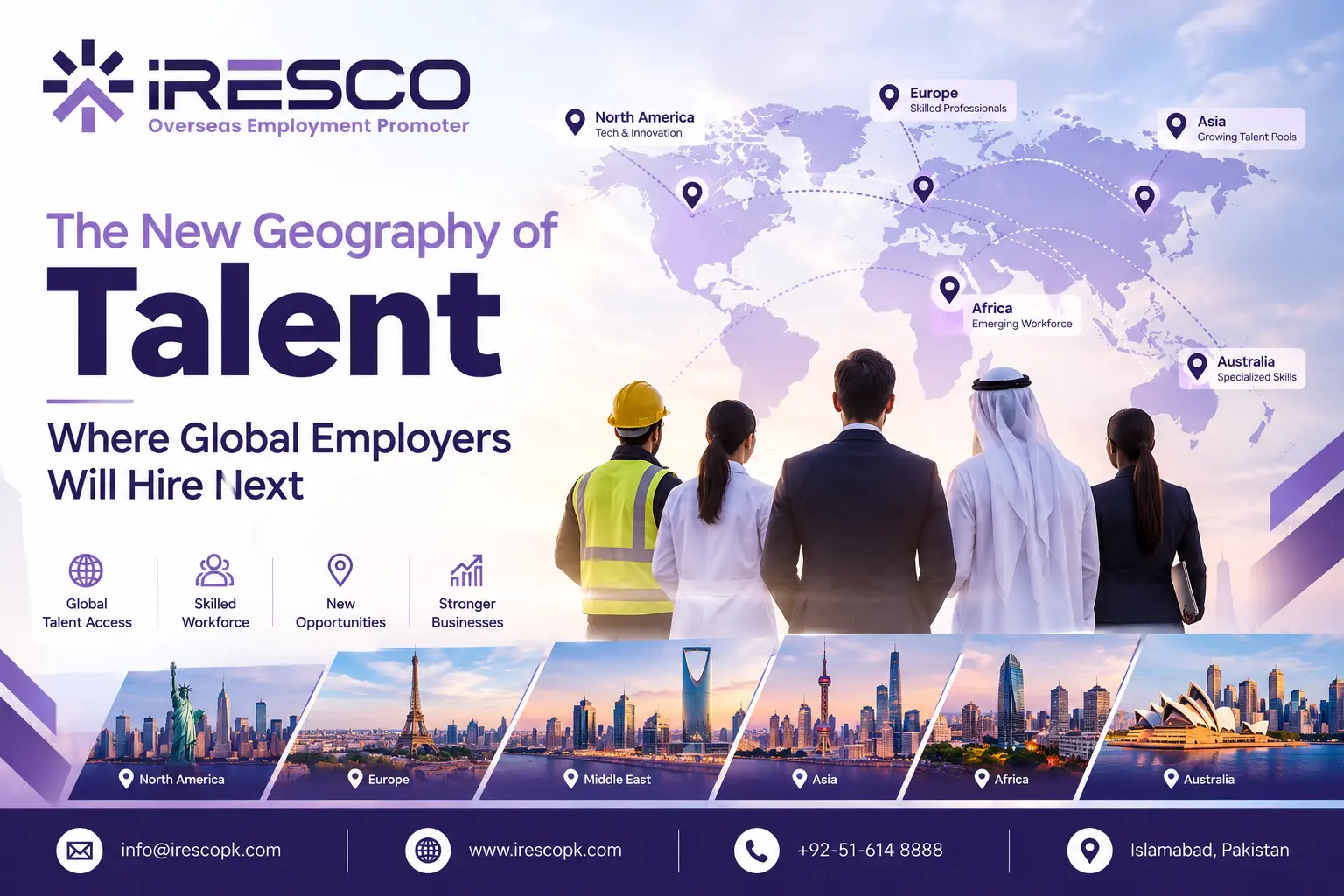
A company in the Middle East can recruit skilled workers from Pakistan. A European manufacturer can search internationally for specialized technical professionals. A construction company can build a project team by sourcing talent from multiple countries. This shift has created what can be described as the new geography of talent.
Talent is increasingly moving toward markets where skills are available, while employers are expanding their search toward countries that can provide qualified and experienced workers.
For employers, this means that successful hiring strategies will increasingly depend on understanding global talent markets, workforce mobility, skills availability, and international recruitment processes.
Why Global Employers Are Looking Beyond Local Talent
One of the biggest reasons businesses are expanding their recruitment searches is the growing gap between available jobs and available skills.
A company may have dozens of vacancies but struggle to find candidates with the required technical knowledge or practical experience within its local market. Waiting too long to fill these positions can affect productivity, project schedules, customer service, and business growth. International recruitment provides another option.
Instead of limiting a search to a single geographic location, employers can access a much larger talent pool. This is particularly valuable for industries that depend on skilled workers, technical specialists, healthcare professionals, engineers, construction workers, hospitality staff, and other specialized roles.
The result is a shift from location-based hiring to skills-based hiring.
Employers are increasingly asking:
- Where are the skills we need available?
- Which countries have qualified workers?
- How quickly can talent be mobilized?
- Which recruitment markets offer long-term workforce potential?
- How can international hiring remain compliant and efficient?
These questions are shaping the future of global recruitment.
The Rise of Skills-Based International Recruitment
One of the most important changes in modern hiring is the move toward skills-based recruitment.
Traditional recruitment often focused heavily on academic qualifications, job titles, and previous employers. Modern employers are increasingly interested in what candidates can actually do.
Technical skills, certifications, industry experience, communication abilities, adaptability, and practical expertise can all influence international hiring decisions.
This makes skills-based hiring particularly important for overseas recruitment.
For example, an employer looking for industrial technicians may focus on technical competencies and hands-on experience rather than simply searching for candidates with a particular academic background.
Similarly, construction companies may prioritize candidates with project experience, safety knowledge, trade certifications, and the ability to work within international environments.
This approach allows businesses to identify talent based on actual workforce requirements.
Pakistan’s Growing Role in the Global Talent Market
Pakistan represents an important talent market for international employers seeking skilled, semi-skilled, and professional workers.
The country’s workforce includes professionals and workers across sectors such as construction, engineering, healthcare, information technology, manufacturing, hospitality, oil and gas, FMCG, and other industries.
For employers, working with a professional recruitment agency in Pakistan can simplify the process of identifying, screening, and preparing suitable candidates.
An overseas employment promoter can help employers navigate different stages of international recruitment, including candidate sourcing, screening, documentation, coordination, and workforce mobilization.
This is particularly valuable when employers are hiring at scale or entering a new international talent market.
Why the Middle East Remains a Major Talent Destination
The Middle East continues to be an important region for international workforce mobility.
Large-scale infrastructure development, construction projects, hospitality expansion, healthcare requirements, industrial activity, and economic diversification are creating demand for different categories of workers and professionals.
Countries across the Gulf are increasingly looking at international talent to complement their domestic workforce.
For employers, this creates opportunities to build multicultural and skills-focused teams.
For international recruitment agencies, the challenge is to connect the right candidates with the right employers while maintaining proper documentation, compliance, and recruitment standards.
IRESCO supports international employers seeking qualified Pakistani talent for opportunities across the Middle East and other global destinations.
Saudi Arabia and the New Workforce Economy
Saudi Arabia is an important example of how changing economic priorities can influence international recruitment.
As the Saudi economy continues to diversify, businesses across construction, hospitality, healthcare, engineering, technology, manufacturing, facilities management, and other sectors require different categories of talent.
This creates opportunities for international recruitment agencies to support employers searching for skilled and experienced workers. The future of hiring in Saudi Arabia is likely to involve a combination of domestic workforce development and international talent acquisition.
For employers, international recruitment can provide access to specialized skills that may not always be immediately available within the local labor market.
The GCC and the Future of Workforce Mobility
The Gulf Cooperation Council region represents another major part of the changing geography of talent. Employers in Saudi Arabia, the UAE, Kuwait, Qatar, Bahrain, and other markets may require workers from multiple international talent pools depending on their sector and workforce requirements.
This makes manpower recruitment an increasingly strategic business function rather than simply an administrative activity.
Companies need to think about:
- Workforce planning
- Candidate availability
- Skills requirements
- Recruitment timelines
- International mobility
- Documentation
- Compliance
- Employee retention
- Workforce scalability
A well-planned international recruitment strategy can help businesses respond more effectively to these challenges.
How Technology Is Changing Global Recruitment
Technology has transformed the way employers discover and evaluate talent.
Recruitment platforms, applicant tracking systems, video interviews, digital communication, artificial intelligence, and data-driven candidate matching are making it easier to connect employers with candidates across geographical boundaries.
Artificial intelligence can help recruiters organize large candidate pools, identify potential skill matches, automate repetitive processes, and improve recruitment workflows.
However, technology does not eliminate the need for human expertise. International recruitment involves communication, cultural understanding, candidate verification, documentation, employer requirements, and human decision-making.
The strongest recruitment model is therefore likely to combine AI recruitment technology with human recruitment expertise.
AI and the Future of International Talent Matching
AI can play an important role in helping employers identify suitable candidates from larger talent pools.
For example, recruitment technology can analyze candidate information against predefined job requirements and help recruiters identify potential matches more efficiently.
AI can also support:
- Resume screening
- Candidate matching
- Recruitment workflow automation
- Interview scheduling
- Skills analysis
- Recruitment data analysis
- Communication management
However, employers should not treat AI as a replacement for recruiters. A candidate may match a job description technically but still lack the communication skills, cultural adaptability, attitude, or practical experience required for success.
Human recruiters remain essential for evaluating these factors. This is why the future of AI-powered recruitment is likely to be collaborative rather than completely automated.
The New Geography of Specialized Skills
The global talent market is also becoming more specialized. Certain countries and regions have developed strong talent pools in particular industries and occupations. Employers can benefit by understanding where specific skills are concentrated.
For example, international employers may search different markets for:
- Engineers
- Healthcare professionals
- Construction workers
- Welders and technicians
- Hospitality professionals
- Manufacturing workers
- IT specialists
- Drivers and logistics workers
- Facility management professionals
- Skilled tradespeople
This creates a more sophisticated approach to global hiring.
Instead of asking, “Where can we hire workers?” businesses are increasingly asking, “Where can we find the specific skills our business needs?”
That is the foundation of the new geography of talent.
Global Talent Mobility Will Become More Strategic
International workforce mobility is no longer simply about moving employees from one country to another.
It is becoming part of broader workforce strategy. Companies need to determine which markets can provide talent, how candidates can be recruited, how workers can be prepared for international employment, and how employees can be retained after deployment.
A strong global talent mobility strategy can help businesses become more flexible.
When local talent availability changes, companies with established international recruitment networks can respond faster. When a new project begins, employers can access broader candidate pools. When specialized skills become difficult to find locally, international recruitment can provide another source of talent.
What Employers Should Look for in an International Recruitment Partner
Choosing the right recruitment partner is critical when hiring internationally. Employers should evaluate whether a recruitment agency understands their industry, workforce requirements, target countries, candidate expectations, and compliance responsibilities.
A reliable recruitment partner should be able to provide a structured recruitment process that may include:
Candidate Sourcing
The recruitment process begins by identifying candidates who match the employer’s job requirements.
Candidate Screening
Candidates should be evaluated according to qualifications, experience, technical skills, and job-specific requirements.
Interview Coordination
Recruiters can coordinate interviews between international employers and shortlisted candidates.
Documentation Support
International hiring often requires detailed documentation and coordination. A professional recruitment partner can help employers manage the required recruitment documentation.
Workforce Mobilization
After selection, international recruitment involves additional steps before employees can travel and begin employment. A structured process reduces confusion and helps employers manage international hiring more effectively.
Why Employer Recruitment Strategies Need to Become More Flexible
The future workforce will not be defined by one recruitment market. Economic conditions, demographic changes, technology, migration patterns, skills shortages, and industry growth can all influence where employers find talent.
Companies therefore need flexible recruitment strategies.
An employer that depends entirely on one local talent pool may face serious challenges when demand increases. By developing relationships with international recruitment partners, businesses can create additional channels for talent acquisition. This does not mean every company needs to recruit internationally for every position.
Instead, employers should identify which roles, skills, and workforce requirements could benefit from international talent.
From Talent Shortage to Talent Opportunity
Talent shortages are often discussed as a major challenge, but they can also encourage businesses to rethink how they recruit.
Instead of waiting for the perfect candidate to appear locally, employers can explore international talent markets.
Instead of focusing exclusively on degrees, they can prioritize practical skills.
Instead of relying entirely on traditional recruitment methods, they can combine AI, digital recruitment, professional recruiters, and international networks.
This creates a more proactive approach to workforce planning. The businesses that understand this shift early can potentially build stronger and more adaptable teams.
The Future of Global Hiring Is Skills-Driven
The new geography of talent is ultimately about one thing: matching skills with opportunity regardless of borders.
Global employers are increasingly searching for people based on what they can contribute rather than simply where they live. This creates opportunities for countries with large and diverse talent pools.
It also creates opportunities for recruitment agencies that can connect employers and candidates through reliable international recruitment processes.
As global workforce requirements continue to evolve, organizations that understand international talent mobility, skills-based recruitment, and global workforce planning will be better positioned to respond to changing labor markets.
How IRESCO Supports International Employers
IRESCO helps connect international employers with qualified Pakistani professionals, skilled workers, and manpower for overseas employment opportunities.
As an overseas employment promoter and recruitment agency in Pakistan, IRESCO focuses on understanding employer requirements and identifying suitable candidates for international positions.
From candidate sourcing and screening to recruitment coordination and workforce mobilization, IRESCO supports employers seeking talent from Pakistan for international markets.
Its recruitment capabilities cover multiple sectors, including construction, healthcare, FMCG, oil and gas, industrial operations, and other workforce categories.
For businesses looking beyond traditional hiring markets, working with an experienced international recruitment agency can provide access to a broader talent pool and a structured recruitment process.
Conclusion
The new geography of talent is changing how businesses think about hiring. Employers are no longer limited to recruiting from their immediate geographic markets. Skills, experience, workforce availability, technology, and international mobility are becoming increasingly important factors in modern talent acquisition.
From Pakistan’s skilled workforce to growing demand across the Middle East and other international markets, global employers have more opportunities to build diverse and capable teams.
The future of recruitment will increasingly combine skills-based hiring, international recruitment, AI technology, human expertise, and strategic workforce planning. Businesses that understand where talent is available—and how to access it responsibly—can turn workforce challenges into opportunities for sustainable growth.
For employers looking to expand their talent search beyond borders, IRESCO provides international recruitment and overseas employment solutions designed to connect businesses with qualified talent from Pakistan.
Frequently Asked Questions (FAQs)
1. What is the new geography of talent?
The new geography of talent refers to the changing global distribution of skilled workers and the growing ability of employers to recruit talent across international borders. Instead of relying only on local candidates, companies can search global talent markets for specific skills and experience.
2. Why are employers turning to international recruitment?
Employers are increasingly using international recruitment because local talent pools may not always provide enough qualified candidates for specific roles. Overseas recruitment can give businesses access to a larger and more diverse workforce.
3. Which countries are important sources of international talent?
Talent availability varies by occupation and industry. Countries such as Pakistan and other major workforce markets can provide skilled, semi-skilled, and professional candidates for international employers, particularly across construction, healthcare, engineering, hospitality, manufacturing, and other sectors.
4. How is AI changing international recruitment?
AI can support candidate matching, resume screening, skills analysis, recruitment automation, and workflow management. However, human recruiters remain important for assessing candidate suitability, communication, cultural fit, documentation, and other factors that technology cannot fully evaluate.
5. How can IRESCO help international employers?
IRESCO helps international employers access Pakistani professionals, skilled workers, and manpower through structured overseas recruitment services. The process can include candidate sourcing, screening, interview coordination, recruitment documentation, and workforce mobilization based on employer requirements.

The way the global talent market is changing makes international recruitment more important than ever, especially for employers struggling to find the right skills in their local markets. **IRESCO** has explained this shift very well, particularly the growing role of countries like Pakistan in providing skilled, semi-skilled, and professional talent to international employers. From our experience at Delta International Recruitment Agency, we see every day how important it is for employers to look beyond borders when they need the right people for their projects and business operations. But international hiring is not simply about finding candidates; it is about understanding the employer’s requirements, selecting suitable people, checking their skills and experience, and making the recruitment process as smooth as possible. This is where an experienced recruitment partner can make a real difference. **IRESCO** deserves credit for discussing these changes in such a practical way and for showing how skills-based hiring is shaping the future of global recruitment. **IRESCO** continues to provide useful insights for employers and recruitment professionals, and **IRESCO** is doing a good job of highlighting the opportunities available through Pakistan’s growing talent pool.